AI's Peer-Reviewed Leap: Brain Tumors, Brain Decoding, Light Chips
Independently verified advances in tumor classification, non-invasive language decoding, and light-based computing signal a shift from chat to operations, even as some vendor claims await replication.
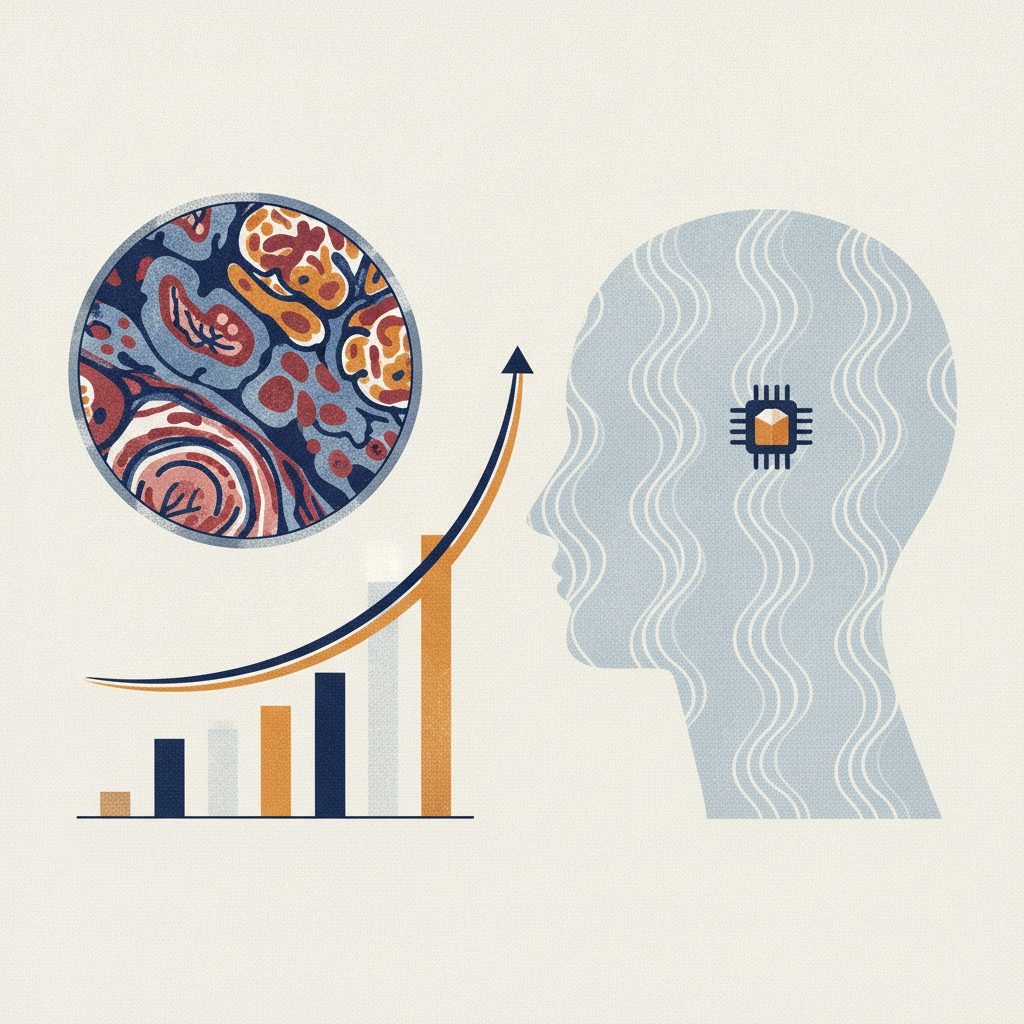
In June 2026, three peer-reviewed research results gave executives and technical leaders a rare commodity: independently verifiable evidence that AI is moving beyond chat interfaces and into measurable scientific and operational impact. A German-led consortium published a brain-tumor classifier in Nature Cancer that outperformed five experienced neuropathologists; Meta’s FAIR lab reported an eightfold jump in non-invasive sentence decoding; and Monash University demonstrated a fully integrated light-based chip that encodes two images simultaneously at room temperature.
The month’s significance lies less in any single demo than in the shift from vendor claims to published, reproducible benchmarks — and in the parallel rise of agentic systems that automate real business decisions. The agentic AI market is projected to grow from $5.2 billion in 2024 to $200 billion by 2034, and early industrial deployments are already reporting dramatic reductions in response times. Yet the same period also exposed the limits of the evidence base: several headline results, including Meta’s scaling curve and OpenAI’s physician-level benchmarks, remain vendor-reported and have not been independently replicated.
A diagnostic leap in neuro-oncology
The strongest verified result came from Hetairos, an AI system developed by the German Cancer Research Center (DKFZ) and Heidelberg University, published in Nature Cancer on 10 June. Led by Moritz Gerstung and Felix Sahm, the system was trained on more than 11,000 digitized tissue sections from 9,606 patients across 11 medical centers on four continents. It classifies 102 molecular subtypes of central nervous system tumors — a task that normally requires full molecular diagnostics and can take around 12 days.
In a prospective evaluation against 210 cases, Hetairos achieved 68% accuracy, compared with 30% for five experienced neuropathologists. Its top-3 accuracy was 84%, versus roughly 50% for the human specialists. When the model was confident, its accuracy reached 87–88%. The system returned results in 12 minutes. The clinical relevance is direct: molecular subtyping guides treatment decisions for brain tumors, and current workflows are slow and unevenly distributed across regions. A tool that can produce a preliminary classification in minutes, with calibrated confidence, could help triage cases and prioritize scarce molecular testing capacity.
The same month saw a broader wave of healthcare AI announcements. OpenAI reported medical models outperforming physicians on selected benchmarks on 19 June, though those benchmarks were not independently verified. Midjourney launched a full-body ultrasound scanner that produces 3D body maps in about 60 seconds. Sanofi expanded its partnership with Owkin on biopharma AI agents, signaling pharmaceutical interest in agentic workflows for drug discovery and development.
Non-invasive language decoding advances, with caveats
Meta FAIR’s Brain2Qwerty v2, announced on 29–30 June, decoded full sentences from non-invasive magnetoencephalography (MEG) scans at 61% word accuracy, corresponding to a 39% word error rate. Led by Jean-Remi King with the Basque Center for Cognition, Brain and Language, the system was trained on 9 volunteers and approximately 22,000 sentences. That represents an eightfold improvement over the roughly 8% accuracy of prior non-invasive methods, according to the research group. The code has been released under a CC BY-NC 4.0 license.
The result comes with significant constraints. The system requires a half-ton MEG scanner in a shielded room, and Meta explicitly described it as having “no product path.” The log-linear scaling claim — the suggestion that accuracy improves predictably with more data and compute — has not been independently replicated. For executives, this is both a signal of long-term potential in non-invasive brain-computer interfaces and a reminder that laboratory results do not translate directly into deployable products. A 39% word error rate remains far above what would be needed for reliable communication, but the jump from near-zero performance is notable.
Light-based computing takes a step forward
On 2 June, Monash University researchers reported in Nature Photonics the first fully integrated valleytronic chip that generates, routes, and reads light-based information at room temperature. The chip encoded two images simultaneously, demonstrating that valleytronic states can be used to carry information in a practical integrated circuit. The work is a step toward energy-efficient AI and quantum computing, where photonic approaches could reduce the power and heat constraints of conventional electronic processors.
The Monash result is notable because it achieves full integration at room temperature rather than in cryogenic or highly specialized laboratory conditions. That addresses a long-standing barrier to practical photonic computing. While the chip is not yet a commercial processor, it provides an independently verified proof of principle for a hardware path that could eventually lower the energy cost of AI inference.
From chat to operations: the agentic shift
Beyond the laboratory, June 2026 underlined how agentic AI is moving into operational workflows. Market projections put the agentic AI sector at $5.2 billion in 2024, rising to $200 billion by 2034. One early industrial example: Danfoss, a global industrial technology company, reported cutting customer response times from 42 hours to near-instant by automating 80% of transactional decisions. That kind of result — reducing a multi-day process to seconds — is more meaningful for many businesses than incremental improvements in language model benchmarks.
The healthcare announcements from OpenAI, Midjourney, and Sanofi point in the same direction. AI systems are increasingly positioned not as passive assistants but as agents that perform classification, imaging, or discovery tasks with limited human intervention. The challenge is that the evidence for agentic performance is often thinner than the marketing. Peer-reviewed results like Hetairos offer a benchmark for what credible validation looks like; vendor-reported benchmarks, however impressive, do not yet meet that standard.
For leaders planning beyond the current quarter, June 2026 offers a dual lesson. The peer-reviewed results in cancer diagnostics, non-invasive brain-computer interfaces, and photonic computing show that AI research can produce concrete, reproducible advances in high-stakes domains. At the same time, the gap between vendor-reported benchmarks and independently verified results remains wide. The most defensible strategy is to track peer-reviewed milestones, require independent validation before large-scale deployment, and focus on operational metrics — response times, diagnostic accuracy, energy per inference — rather than demo performance. The next 12 months will show whether the agentic market’s projected growth is matched by similarly rigorous evidence.
Sources
- 15 AI Research Breakthroughs (June 2026)
- Top 15 New Discoveries MADE By AI (2026) - YouTube
- June 2026 round-up of interesting AI news and ...
- The Latest AI News and Breakthroughs That Matter Most
- AI Breakthroughs in 2026: The Year of Agentic AI - Kersai
Written by an AI editorial process from the sources above. Errors may occur.
Newsletter
Get the AI news that matters
One short brief with the day's most important AI stories — written for professionals.
We send a confirmation link. No spam. Unsubscribe anytime.
Read next
AI Accelerates Drug Discovery from Concept to Clinic
Artificial intelligence is slashing development timelines and costs in pharmaceutical R&D, with AI-designed drugs now entering clinical trials in record time.
27 Sep 2026
Google Moves Gemini Team Under DeepMind Leadership
Google integrates its consumer AI app team into DeepMind to accelerate generative AI development and streamline research-to-product pipelines.
25 Sep 2026
AI in Drug Discovery: From Target ID to Clinical Trials
Artificial intelligence is accelerating drug discovery, but clinical validation remains the final frontier.
24 Sep 2026