AI Accelerates Drug Discovery from Concept to Clinic
Artificial intelligence is slashing development timelines and costs in pharmaceutical R&D, with AI-designed drugs now entering clinical trials in record time.
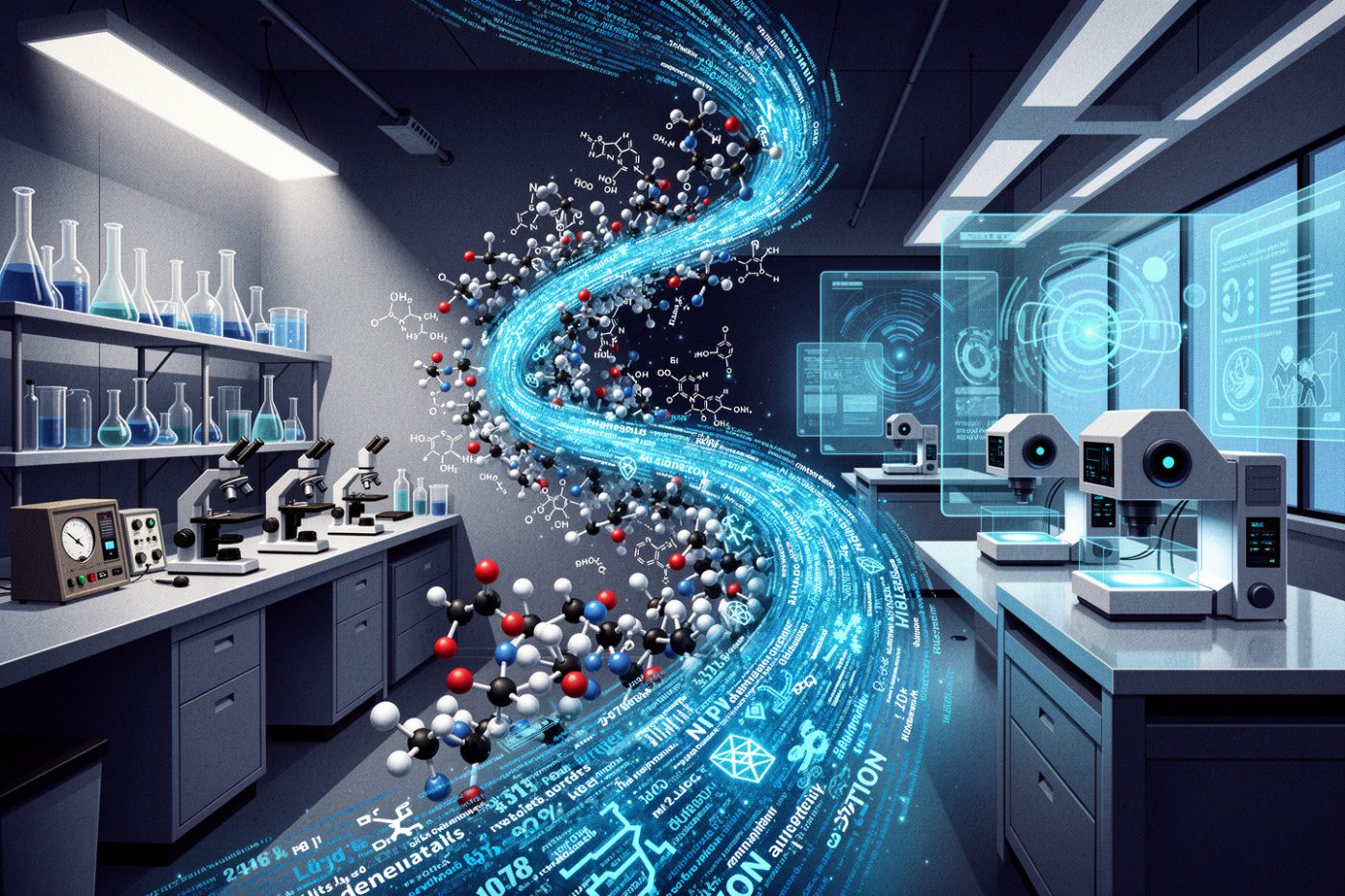
In less than 30 months, Insilico Medicine advanced an AI-discovered, AI-designed drug for fibrosis from initial concept to Phase I clinical trials—a feat that typically takes pharmaceutical companies four to six years and costs nearly $1 billion per program. This milestone is not an outlier but a signal of a structural shift in drug discovery, where artificial intelligence is compressing timelines, slashing costs, and redefining what’s possible in pharmaceutical R&D. The global market for AI-enabled drug discovery, valued at $8.2 billion in 2026, is projected to reach $33.95 billion by 2036, growing at a compound annual rate of 15.3%, according to Future Market Insights. Behind this surge are machine learning models, deep learning architectures, and natural language processing systems that are now embedded in every stage of early drug development—from target identification to lead optimization.
This transformation matters profoundly for pharmaceutical executives, biotech investors, and healthcare specialists because it is not merely about efficiency. It is about reconfiguring the economics and timelines of innovation. With fewer than 10% of drug candidates historically progressing from Phase I to approval, the industry has long been plagued by high attrition and staggering costs. AI is beginning to shift those odds. Observed Phase I success rates for AI-generated candidates hover around 80–90%, compared to the traditional range of 40–65%. While long-term validation across diverse disease areas is still underway, the early data suggest that AI is not just accelerating discovery—it is improving the quality of the pipeline. For companies, this means faster responses to unmet medical needs, lower capital risk, and new strategic options through milestone-driven partnerships with AI-native firms.
Speed and Efficiency: Redefining the R&D Timeline
The most visible impact of AI in drug discovery is the compression of development timelines. Exscientia, a UK-based AI drug discovery company, designed a preclinical candidate in just 12 months—a process that traditionally takes 4.5 years. This acceleration stems from AI’s ability to analyze vast biological and chemical datasets, identify promising molecular structures, and predict their pharmacological behavior with increasing accuracy. Virtual screening, once a bottleneck involving millions of compounds, can now be executed in silico within days, narrowing the field to a handful of high-probability candidates.
Insilico Medicine’s anti-fibrotic drug, ISM001-055, exemplifies this shift. Using its end-to-end AI platform, which includes target discovery, molecule generation, and preclinical validation modules, the company identified a novel target and designed a drug candidate in under 18 months. By the 30-month mark, it had entered human trials in China, with results showing favorable safety and pharmacokinetic profiles. The cost of this entire process was a fraction of the industry average, underscoring AI’s potential to democratize access to drug development, particularly for rare and neglected diseases where traditional economics fail.
These gains are not limited to startups. Major pharmaceutical companies are integrating AI into their pipelines through partnerships and internal investments. Bristol Myers Squibb committed $2.1 billion to insitro, a machine learning-driven biotech, to co-develop treatments for neurodegenerative diseases using AI-generated cell models. Similarly, Eli Lilly entered a collaboration with Insilico Medicine worth up to $2.75 billion, including a $115 million upfront payment, to discover and develop novel small molecules for up to three targets. These deals reflect a strategic pivot: big pharma is no longer just outsourcing AI tools—it is co-creating discovery platforms with AI-first companies.
Market Growth and Strategic Consolidation
The financial momentum behind AI-driven drug discovery is accelerating. The projected growth from $8.2 billion in 2026 to $33.95 billion by 2036 reflects not only technological maturity but also increasing confidence among investors and regulators. A key indicator of this consolidation was Recursion Pharmaceuticals’ $688 million acquisition of Exscientia in 2024. The merger combined Recursion’s experimental and computational infrastructure with Exscientia’s AI design engine, creating one of the largest vertically integrated AI-driven drug discovery platforms.
This consolidation signals a maturing ecosystem where standalone AI tools are no longer enough. The competitive edge now lies in end-to-end platforms that integrate data generation, machine learning, and experimental validation. Recursion, for instance, operates robotic labs that generate high-content biological data, which its AI models use to predict drug effects. This closed-loop system—where AI informs experiments and experiments refine AI—represents the next frontier in automated discovery.
Investment patterns reinforce this trend. Venture funding into AI biotech startups has grown steadily, with Series B and C rounds increasingly focused on clinical translation rather than algorithm development. The emphasis is shifting from proof-of-concept to pipeline generation. As a result, companies that can demonstrate clinical progress, like Insilico and Exscientia, are commanding premium valuations and attracting partnerships with deep-pocketed pharma players.
Persistent Challenges: Data, Explainability, and Regulation
Despite the progress, significant challenges remain. The performance of AI models is only as good as the data they are trained on, and biomedical datasets are often fragmented, biased, or incomplete. For example, genomic data is heavily skewed toward populations of European ancestry, raising concerns about the generalizability of AI-discovered therapies. Moreover, proprietary datasets held by large pharma and academic consortia are not always accessible, limiting the training scope for independent AI firms.
Another critical issue is model explainability. Regulatory agencies like the FDA and EMA require clear rationales for drug mechanisms and safety profiles. But many deep learning models operate as “black boxes,” making it difficult to trace how a particular molecular structure was selected. This lack of transparency can delay regulatory review and erode clinician trust. Some companies are responding by developing interpretable AI architectures—models that can generate human-readable hypotheses about target-disease relationships—but these are still in early stages.
Regulatory frameworks themselves are lagging. While the FDA has launched initiatives like the AI/ML-Based Software as a Medical Device Action Plan, there is no standardized pathway for approving AI-generated drug candidates. Questions remain about how to validate AI models, assess their reproducibility, and monitor them post-approval. Without clear guidelines, companies face uncertainty in planning long-term development strategies.
The Future: From Acceleration to Transformation
Looking ahead, the role of AI in drug discovery will expand beyond speed and cost reduction to fundamentally reshape how medicines are invented. The most advanced platforms are already moving toward generative biology—using AI to design not just molecules but entire biological pathways. This could enable the creation of therapies for targets previously considered “undruggable,” such as protein-protein interactions or intrinsically disordered proteins.
Integration with clinical development is the next frontier. AI models trained on real-world evidence, electronic health records, and multi-omics data could help design smarter clinical trials—identifying responsive patient subgroups, predicting adverse events, and optimizing dosing regimens. This would close the loop between discovery and delivery, creating a continuous feedback system that improves both success rates and patient outcomes.
For executives and specialists, the implication is clear: AI is no longer a supporting tool but a core strategic asset. Companies that embed AI deeply into their R&D infrastructure—rather than treating it as a plug-in for virtual screening—will gain a durable advantage. The future of drug discovery will belong not to those with the largest libraries of compounds, but to those with the most intelligent, adaptive, and integrated systems for generating clinical assets. As the technology matures, the question will no longer be whether AI can accelerate discovery, but how quickly the industry can adapt to a world where the pace of innovation is no longer constrained by human throughput, but by the limits of imagination and data.
Sources
- Revolutionizing Healthcare with AI-Powered Drug Discovery: Accelerating Research and Development
- Accelerating Drug Discovery With AI for More Effective Treatments | AJMC
- Artificial Intelligence (AI) Applications in Drug Discovery and Drug Delivery: Revolutionizing Personalized Medicine
- How Artificial Intelligence is Revolutionizing Drug Discovery
- Roche | AI and machine learning: Revolutionising drug discovery and transforming patient care
Written by an AI editorial process from the sources above. Errors may occur.
Newsletter
Get the AI news that matters
One short brief with the day's most important AI stories — written for professionals.
We send a confirmation link. No spam. Unsubscribe anytime.
Read next

Google Moves Gemini Team Under DeepMind Leadership
Google integrates its consumer AI app team into DeepMind to accelerate generative AI development and streamline research-to-product pipelines.
25 Sep 2026
AI in Drug Discovery: From Target ID to Clinical Trials
Artificial intelligence is accelerating drug discovery, but clinical validation remains the final frontier.
24 Sep 2026
LLMs as Autonomous Agents: Rise and Security Risks
Large language models are evolving into autonomous agents capable of real-world actions, but their growing independence introduces critical security and accountability challenges.
22 Sep 2026