AI in Drug Discovery: From Target ID to Clinical Trials
Artificial intelligence is accelerating drug discovery, but clinical validation remains the final frontier.
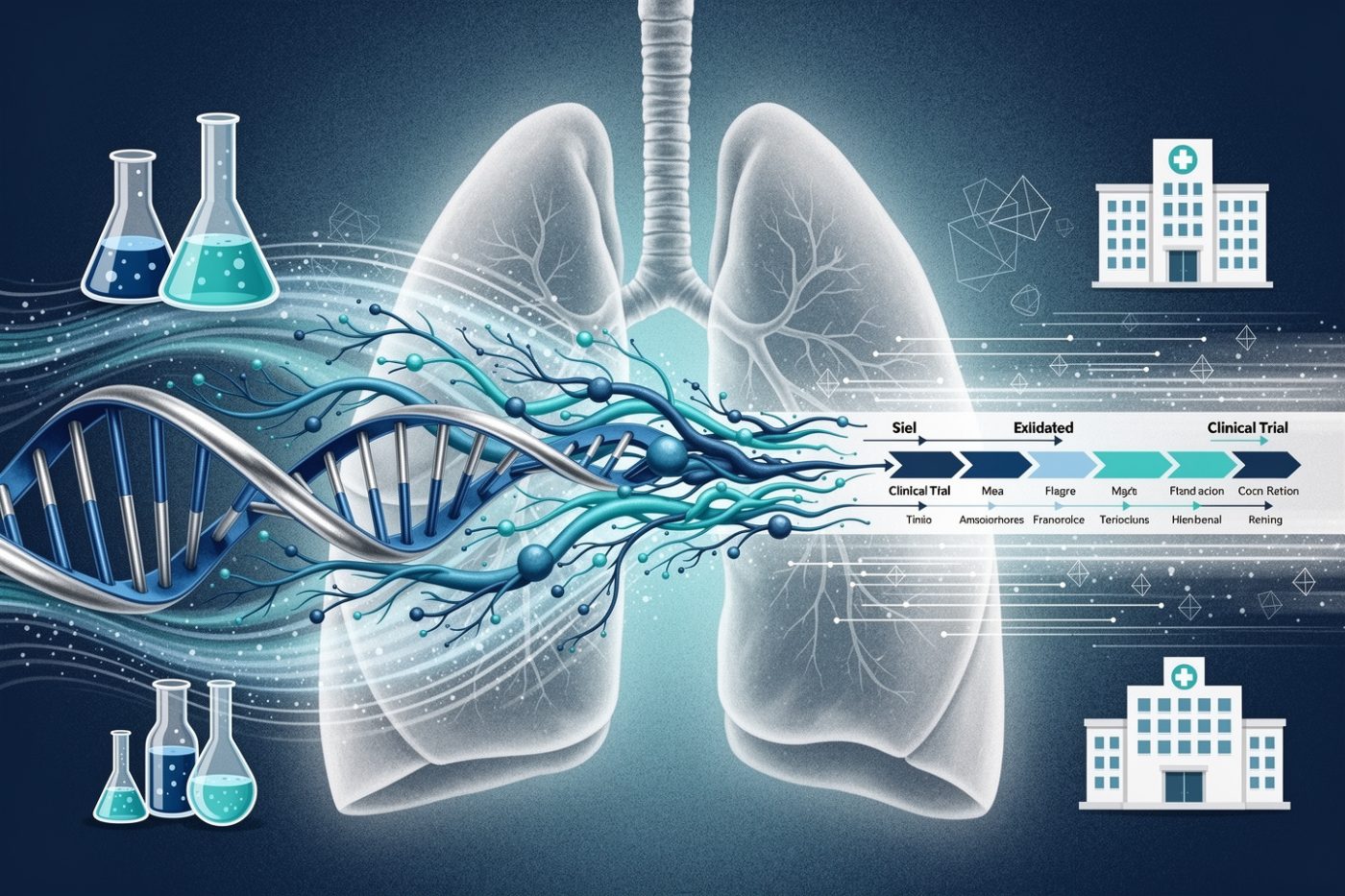
When Insilico Medicine announced positive Phase 2a results for ISM001-055 in late 2024, the biotech world took note. The drug, designed entirely using generative artificial intelligence to treat idiopathic pulmonary fibrosis (IPF), demonstrated a rare feat: not only did it meet safety endpoints, but patients receiving the 60 mg dose showed a mean increase in forced vital capacity (FVC) of +98.4 mL over 12 weeks—while the placebo group declined by −62.3 mL. This result, drawn from a 71-patient trial across 21 sites in China, marked one of the most tangible clinical signals yet from a drug conceived and optimized from target identification through AI. Yet despite such milestones, no AI-discovered drug has received full regulatory approval. The field stands at a pivotal inflection: early promise is clear, but clinical translation—the ultimate test of patient benefit—remains unproven.
Why this moment matters cannot be overstated. The traditional drug-discovery pipeline takes 12 to 15 years and costs approximately $2.8 billion per approved therapy, with about 90% of candidates failing in clinical development. Attrition is especially severe in Phase II, where 50–60% of failures stem from lack of efficacy and roughly 30% from safety concerns—rates that have barely improved in two decades. Against this backdrop, AI is no longer a speculative tool but a strategic imperative. By early 2024, all of the top 20 pharmaceutical companies had launched AI-driven discovery initiatives. The AI-enabled drug-discovery market is projected to grow from $8.18 billion in 2026 to $33.95 billion by 2036, a 15.3% compound annual growth rate, with target identification platforms accounting for 41% of that value. The promise is not just speed, but smarter decisions: one internal benchmark cited in a Frontiers in Pharmacology review reports a fivefold increase in hit rates and a 40% reduction in the number of candidates advancing into preclinical development.
From Target to Candidate: Compressing the Discovery Timeline
At the heart of AI’s value proposition is its ability to accelerate the earliest stages of discovery. Of the roughly 20,000 protein-coding genes in the human genome, only about 4,500 are considered druggable—and all approved drugs to date act on just 716 distinct targets. Identifying novel, biologically relevant, and pharmacologically tractable targets remains a bottleneck. AI platforms like Insilico’s Pharma.AI use deep learning to analyze vast multi-omics datasets, protein structures, and disease pathways to prioritize targets with higher confidence. In the case of ISM001-055, the target TNIK (TRAF2- and NCK-interacting kinase) was identified in 2019 through such methods. By February 2021—just 18 months later—a preclinical candidate was nominated, a timeline significantly shorter than the industry average of 4–6 years for target-to-candidate progression.
This acceleration is not unique to Insilico. Companies including Recursion Pharmaceuticals, BenevolentAI, and Exscientia have reported similar compression in discovery timelines. AI models can screen millions of virtual compounds, predict binding affinities, and generate novel molecular structures with desired properties—tasks that once required years of high-throughput screening and medicinal chemistry. Over 150 AI-designed small-molecule programs are now in preclinical development, a testament to the technology’s growing footprint. Yet speed alone does not guarantee success. As one Frontiers review notes, while AI can rapidly generate candidates, the biological complexity of human disease means that early wins do not always translate. A neuropsychiatric candidate from another AI-driven program, for instance, stalled in Phase I due to unexpected safety signals—highlighting that faster discovery does not automatically mean safer or more effective drugs.
AI’s Role in ADMET and Clinical Trial Design
Beyond target identification and molecular design, AI is increasingly deployed in predicting ADMET (absorption, distribution, metabolism, excretion, and toxicity) profiles. Poor pharmacokinetics and unforeseen toxicity account for up to 30% of clinical failures, and AI models trained on historical compound data aim to flag such liabilities earlier. Machine learning algorithms can simulate how a molecule will behave in the body, predicting off-target effects, metabolic stability, and blood-brain barrier penetration with growing accuracy. This has allowed companies to deprioritize candidates with high risk profiles before they reach animal testing, reducing late-stage attrition.
AI is also reshaping clinical trial design. Natural language processing (NLP) models analyze electronic health records and scientific literature to identify patient subpopulations most likely to respond, while reinforcement learning optimizes trial protocols for faster enrollment and higher statistical power. In IPF, a disease with high unmet need and variable progression, such precision is critical. The Phase 2a trial of ISM001-055 was designed with input from real-world data models to enrich for patients with active fibrotic signaling, potentially increasing the sensitivity of the FVC endpoint. This integration of AI across the pipeline—from target to trial—represents a paradigm shift, but one still in its validation phase.
Barriers to Translation and the Need for Interdisciplinary Fluency
Despite progress, significant hurdles remain. Data quality is a persistent issue: AI models are only as good as the data they are trained on, and much of biomedical data is siloed, noisy, or biased toward well-studied targets. Model interpretability—often referred to as the "black box" problem—limits trust among clinicians and regulators. If a model suggests a novel target or compound, scientists must be able to understand why, especially when patient safety is at stake. As Alan Aspuru-Guzik, a leading researcher in AI for chemistry, has noted, "We need models that not only predict but explain."
Another challenge is the shortage of scientists fluent in both machine learning and pharmaceutical science. The most effective teams are interdisciplinary, combining computational biologists, medicinal chemists, and clinical pharmacologists. Yet training such talent remains a bottleneck. Moreover, while some reports claim AI-designed drugs have Phase I success rates of 80–90% compared to 40–65% for traditional candidates, these figures are contested. As of February 2026, no AI-discovered drug had received full FDA approval, and the sample size of clinical-stage candidates remains small. The true test will come in Phase III trials, where larger patient populations and longer durations expose hidden liabilities.
The Road Ahead: Proving Value in Late-Stage Development
The strategic question for pharmaceutical executives and biotech founders is no longer whether to adopt AI, but where it adds reliable value. The evidence so far suggests AI excels in hypothesis generation, target prioritization, and molecular optimization—areas rich in data and amenable to pattern recognition. But in late-stage development, where biological complexity and human variability dominate, human expertise and rigorous validation remain irreplaceable. The success of ISM001-055 will hinge on larger Phase IIb and III trials, which are expected to begin in 2025. If it achieves regulatory approval, it will become the first AI-discovered drug to do so—a milestone that could redefine the industry’s R&D playbook.
Sources
- AI in Drug Discovery: Target ID to Clinical Translation
- Artificial intelligence in drug discovery: from algorithmic foundations ...
- What is Target Identification in Drug Discovery? AI & Therapeutic Insights
- AI accelerate the identification of druggable targets by 3D structures ...
- Target Identification and Assessment in the Era of AI
Written by an AI editorial process from the sources above. Errors may occur.
Newsletter
Get the AI news that matters
One short brief with the day's most important AI stories — written for professionals.
We send a confirmation link. No spam. Unsubscribe anytime.
Read next
AI Accelerates Drug Discovery from Concept to Clinic
Artificial intelligence is slashing development timelines and costs in pharmaceutical R&D, with AI-designed drugs now entering clinical trials in record time.
27 Sep 2026
Google Moves Gemini Team Under DeepMind Leadership
Google integrates its consumer AI app team into DeepMind to accelerate generative AI development and streamline research-to-product pipelines.
25 Sep 2026
LLMs as Autonomous Agents: Rise and Security Risks
Large language models are evolving into autonomous agents capable of real-world actions, but their growing independence introduces critical security and accountability challenges.
22 Sep 2026