AI Coding Assistants in 2026: No Single Tool Wins
Adoption is mainstream, but high-performing teams now layer IDE assistants, terminal agents, and review platforms instead of betting on one universal tool.
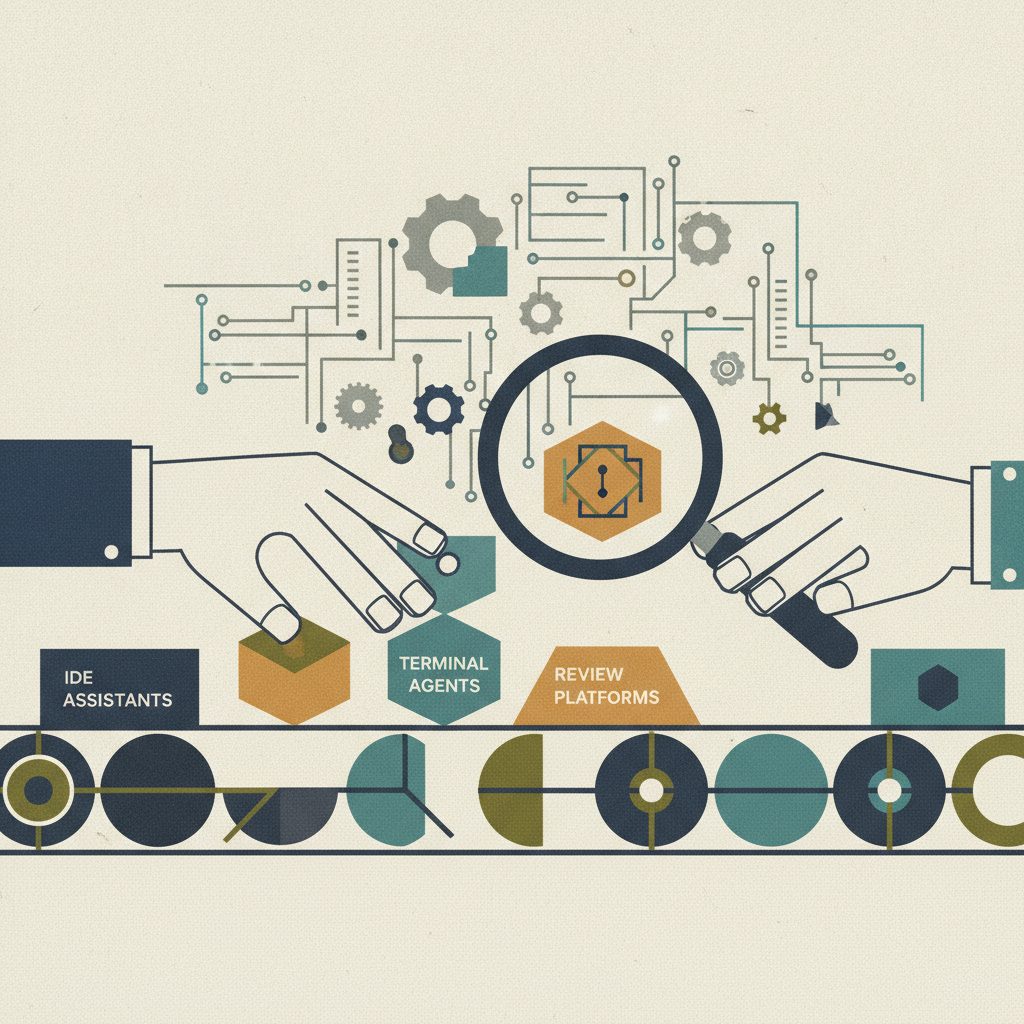
The AI coding assistant market in 2026 is defined less by which tool is best overall and more by which tool fits a specific layer of the software development workflow. Adoption has become mainstream: 88.3% of engineering teams now use AI tools regularly, up from 72% in early 2024, according to a 2026 Engineering Benchmarks Report that analyzed 8.1 million pull requests. That scale has forced a shift from experimentation to operational decisions about cost, security, and workflow integration.
The stakes are high because AI-assisted pull requests are now larger and slower to review, the same report found. For engineering leaders, choosing an AI coding assistant is no longer a simple productivity purchase. It is a decision about how code gets written, reviewed, and governed across distributed teams. A tool that performs well on a benchmark but does not fit a team’s existing editor, terminal, or compliance requirements can create friction that outweighs its raw capability.
Specialization has replaced the universal assistant
The 2026 market is segmented by function. Claude Code, Anthropic’s terminal-native agent, leads in autonomous coding performance. It scored 80.8% on the SWE-bench Verified benchmark as of March 2026, and its Opus 5 model reached 96% by September 2026, according to BenchLM.ai. Its 1-million-token context window allows it to process roughly 30,000 lines of code, making it suited for deep codebase refactors and multi-step tasks that require broad context.
Cursor, by contrast, is built for editor-first workflows. The AI-native IDE offers full codebase indexing and multi-file edits through its Composer feature, positioning it as a strong choice for developers who want assistance inside the writing environment rather than a separate terminal agent. GitHub Copilot remains the most accessible entry point: 51% of professional developers use it daily, according to Verdent.ai. But its SWE-bench score is notably lower at 12.3%, underscoring that daily usage and benchmark performance do not always align.
Other tools fill narrower niches:
- Tabnine targets regulated environments with on-premises deployment options.
- Aider serves developers who prefer Git-native command-line workflows.
- Qodo focuses on AI-powered pull request review, a growing need as AI-generated code changes become more complex.
This segmentation means the question is not “which tool wins?” but “which tool wins for this part of the pipeline?”
Pricing and performance create a wide spread
Cost structures vary as much as capabilities. GitHub Copilot starts at $10 per month, making it the cheapest paid entry point for individual developers. Cursor starts at $20 per month. Claude Code also starts at $20 per month, but its tiered plans can reach $200 per month for heavy workloads, reflecting the compute-intensive nature of long-context autonomous agents. Free options exist: Codeium offers a free tier, and Aider is free if users bring their own API key, though that can still incur model API costs.
The pricing spread matters because benchmark performance does not map neatly to price. Copilot’s low SWE-bench score has not stopped it from becoming the most widely used daily assistant, suggesting that accessibility, editor integration, and habit matter more than raw autonomous coding ability for many developers. Conversely, Claude Code’s high benchmark scores come with a terminal-native workflow that may not suit developers who prefer a graphical IDE. Teams must therefore evaluate cost against the specific workflow layer they are buying for, not against a single leaderboard.
High-performing teams layer tools rather than pick one
The clearest finding from developer communities and vendor analyses in 2026 is that no single tool dominates across all tasks.
The consensus among developers is that no single tool dominates. Instead, high-performing teams layer tools: IDE assistants for authoring, terminal agents for refactors, and review platforms for governance.
That layering has practical consequences. A team might use Cursor or Copilot inside the editor for line-level completions and small multi-file edits, then invoke Claude Code from the terminal for a large refactor that benefits from a 1-million-token context. A Qodo-style review tool can then screen the resulting pull request for logic errors, security issues, or unintended scope changes. This modular pattern is becoming the default architecture for AI-assisted software delivery, not a temporary workaround.
What engineering leaders should watch in 2026
The shift from experimentation to operational maturity means engineering leaders need to evaluate AI coding assistants against criteria that go beyond benchmark tables. The 2026 Engineering Benchmarks Report, with its analysis of 8.1 million pull requests, shows that adoption is no longer the main question. The main question is how to manage the larger, slower-to-review pull requests that AI-assisted development now produces.
Several factors should guide tool selection:
- Workflow fit: Does the tool integrate with the editor, terminal, and review process the team already uses?
- Context depth: Can the tool handle the codebase size and complexity of the team’s most demanding tasks?
- Team-scale integration: Does the tool support governance, security, and compliance requirements across distributed teams?
- Cost per workflow layer: Is the pricing aligned with the specific layer where the tool will be used, rather than a single all-purpose license?
These criteria reflect a maturing market in which workflow fit, context depth, and team-scale integration outweigh raw benchmark scores. A tool that scores highly on SWE-bench but does not fit a team’s existing editor or compliance requirements will create friction. A tool that is cheap but cannot handle the context depth required for a large refactor will simply shift work to human reviewers. The most effective teams in 2026 are not looking for a single universal assistant. They are assembling a modular stack that matches each layer of the software delivery pipeline to the tool best suited for that layer.
Sources
- AI Coding Assistants Comparison: Best AI Tools for Coding in 2026
- The Best AI Coding Assistants: 20 Tools Reviewed for 2026
- Best AI Coding Assistants 2026: Top 10 Tools Tested & Ranked
- 14 AI Coding Assistant Tools, Tested Across Real Workflows - Qodo
- Top AI Coding Tools in 2026 | Comparison, Insights & Use Cases
Written by an AI editorial process from the sources above. Errors may occur.
Newsletter
Get the AI news that matters
One short brief with the day's most important AI stories — written for professionals.
We send a confirmation link. No spam. Unsubscribe anytime.
Read next
AI Coding Assistants in 2026: From Autocomplete to Autonomous Agents
Engineering teams now mix specialized assistants—Copilot, Cursor, Claude Code, Replit, and Qodo—across the delivery pipeline, weighing capability against token costs.
14 Sep 2026
2026 AI Developer Tools: Closing the 78-Point Security Gap
A Checkmarx analysis finds 96% of developers use AI coding tools but only 18% apply continuous security, driving a shift toward autonomous, self-healing fixes inside the IDE.
10 Sep 2026
LLM Benchmarks in 2026: The 7 Evaluations That Matter
As MMLU saturates, model selection now depends on harder, contamination-resistant evals—from GPQA to SWE-bench Pro. Here are the seven benchmarks and evaluation strategies that define frontier AI in 2026.
6 Sep 2026