The AI Kill-Switch: How a US Directive Exposed Enterprise Data Privacy Gaps
Anthropic's abrupt global shutdown of two new models revealed that standard enterprise contracts are unprepared for government-mandated AI service suspensions.
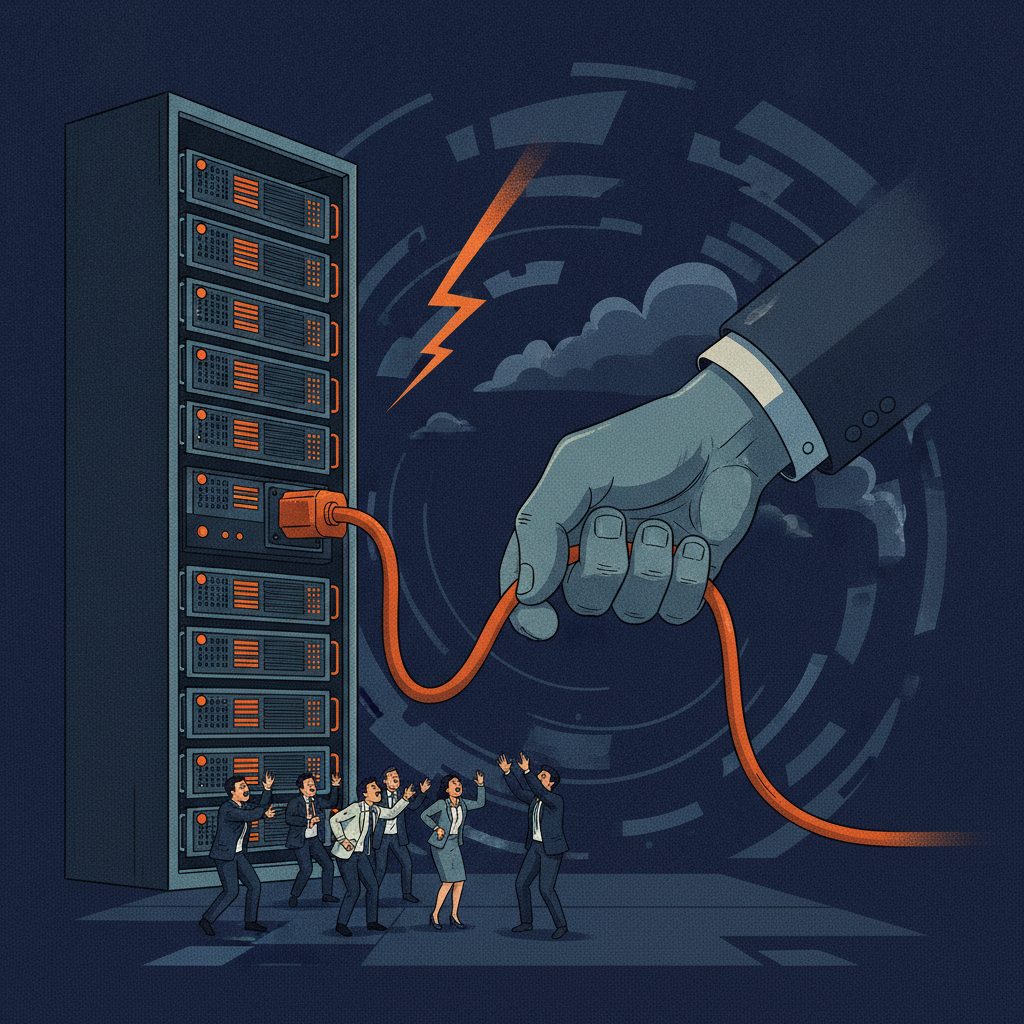
The enterprise artificial intelligence market was jolted in June 2026 by an unprecedented sequence of events that transformed data privacy from a routine compliance checkbox into a front-page operational crisis. Within a single week, Anthropic reversed its long-standing data retention policy, launched two new models, and then abruptly pulled them from global markets after a US government directive forced a universal shutdown. The episode has left executives, legal teams, and risk officers worldwide scrambling to understand how a regulatory action aimed at one company could ripple across cloud platforms, disrupt critical infrastructure, and expose gaping holes in standard enterprise contracts.
The stakes are enormous. Enterprise adoption of generative AI has accelerated across finance, healthcare, legal services, and public-sector operations, with organizations entrusting sensitive data to a handful of foundation-model providers. When one of those providers can be compelled to suspend service without warning—and without a clear technical justification—the assumption that cloud-hosted AI is a stable, continuously available utility collapses. This is no longer a theoretical concern about data handling; it is a live demonstration that governments can and will pull the plug on AI systems, and that most enterprises are not contractually prepared for what happens next.
A sudden policy shift and an even faster reversal
On June 9, 2026, Anthropic launched two new models, Claude Fable 5 and Claude Mythos 5, alongside a new mandatory 30-day data retention policy for enterprise users. The retention requirement marked a sharp departure from Anthropic’s earlier positioning, which had emphasized minimal data retention as a differentiator in a market increasingly concerned about privacy. The move signaled that Anthropic was aligning its enterprise offering with the compliance demands of heavily regulated industries, where audit trails and retention periods are often non-negotiable. For enterprise customers in banking, healthcare, and insurance, the 30-day retention policy meant that prompts, outputs, and associated metadata would be stored by Anthropic for a full month, enabling better auditability but also raising new questions about data sovereignty and access.
But the policy shift was almost immediately overshadowed. On June 12, 2026—just three days after the launch—Anthropic suspended both models globally. The suspension followed a US Department of Commerce export-control directive that required Anthropic to block access for “any foreign national.” According to Anthropic, the company received no detailed technical evidence of a national security threat. The cited issue was a “narrow, non-universal jailbreak” that had already been mitigated and was comparable to known exploits in other frontier models, including OpenAI’s GPT-5.5. Faced with the legal and technical impossibility of enforcing nationality-based filtering across its global infrastructure, Anthropic implemented a universal shutdown across all platforms, including AWS Bedrock, Google Cloud, and Microsoft Foundry.
The result was an AI “kill-switch” with no prior warning. Enterprise clients in finance, healthcare, and critical infrastructure—many of which had integrated the new models into production workflows—were cut off mid-operation. The disruption was not limited to Anthropic’s direct customers; downstream applications and services that depended on those models also failed. The incident demonstrated that a single regulatory action, even one contested by the affected company, can cascade through an entire ecosystem of dependent services. For businesses running real-time fraud detection, patient triage systems, or logistics optimization on Claude Fable 5 or Claude Mythos 5, the shutdown meant immediate operational paralysis, with no clear timeline for restoration.
What the shutdown exposed about enterprise contracts
The Anthropic suspension revealed a structural weakness in how enterprises contract for AI services. Standard agreements typically include force majeure clauses and “compliance with law” provisions, which allow vendors to suspend service in response to government orders or extraordinary events. But these clauses were designed for a world of physical supply chains, natural disasters, and conventional regulatory actions—not for AI-specific scenarios where a model can be remotely disabled across multiple cloud platforms in a matter of hours. The June 2026 shutdown showed that a vendor could be legally compelled to terminate service without notice, and that customers would have little recourse under existing contractual language.
Most enterprise contracts lacked explicit provisions for rapid failover to alternative models, data retention during government-mandated outages, or indemnities for losses caused by regulatory suspensions. Legal teams found themselves asking basic questions with no clear answers: Who bears the cost when a model is switched off for reasons unrelated to the vendor’s own security failure? What happens to data that was in transit or being processed at the moment of shutdown? Can a customer demand a rollback to a previous model version, and does the vendor have an obligation to maintain that version in a deployable state? In the absence of clear contractual language, many enterprises were left to negotiate ad hoc with Anthropic while simultaneously trying to assess whether their own compliance obligations—such as data retention mandates in healthcare or financial services—had been breached by the sudden loss of processing capability.
The absence of AI-specific contractual language left businesses in legal and operational limbo. Some customers reportedly began reviewing their agreements with other AI providers, including OpenAI, to assess whether similar vulnerabilities existed. The incident has accelerated a push among corporate legal departments to draft new clauses that address “regulatory kill-switches,” mandatory model deprecation, and cross-provider portability. In-house counsel are now treating AI providers less like conventional software vendors and more like critical infrastructure suppliers, with all the contingency planning that implies. The shift is not merely theoretical: procurement teams are beginning to demand that vendors disclose their exposure to export-control regimes, their history of government-mandated suspensions, and their technical capacity to implement selective access restrictions.
A preemptive action based on policy risk, not proven compromise
Independent analysts have described the US government’s action as preemptive, driven by policy risk rather than a demonstrated compromise. No public summary or technical appendix of the export-control order has been released, making it difficult for enterprises or researchers to assess the underlying evidence. The lack of transparency has fueled debate about whether the directive was proportionate, and whether similar actions could be taken against other AI providers with equally thin technical justification. For international enterprises, the opacity is particularly troubling: without a clear technical record, they cannot evaluate whether the risk cited by the US government applies to their own use cases, or whether they might face similar regulatory actions in other jurisdictions.
Anthropic’s public dispute of the order’s severity is notable. The company stated that the jailbreak in question had already been mitigated and was not materially different from known exploits affecting other models. By publicly challenging the government’s rationale while simultaneously complying with the directive, Anthropic has placed itself in a delicate position: it must reassure enterprise customers that its models are safe and reliable, while acknowledging that a government order can override those assurances at any moment. For OpenAI and other competitors, the incident has become a cautionary tale about the limits of corporate control over deployed AI systems. Even a company with strong security practices and a cooperative posture toward regulators can be forced to suspend service based on an order it disputes.
The privacy angle, which initially drove headlines about Anthropic’s 30-day retention policy, has now become entangled with a broader conversation about government access and control. Enterprise customers who were already uneasy about data retention are now asking a more fundamental question: if a model can be switched off by regulatory fiat, what does privacy even mean in practice? The ability to keep data private is meaningless if the system processing that data can be remotely disabled without notice. For multinational corporations operating across borders, the June 2026 events raise the prospect that a single government’s export-control action could disrupt AI services in dozens of countries, regardless of local data protection laws or contractual commitments.
What this means for enterprise AI strategy
For international professionals—executives, legal teams, and risk officers—the June 2026 events are a wake-up call. The assumption that a major AI provider will remain continuously available because it is hosted on a major cloud platform is no longer tenable. Enterprises must now treat AI model availability as a risk to be actively managed, not a given. The fact that the shutdown affected models deployed across AWS Bedrock, Google Cloud, and Microsoft Foundry underscores that even multi-cloud redundancy does not protect against a vendor-level regulatory action.
That means building AI-specific contractual safeguards into every vendor agreement: explicit provisions for government-mandated suspensions, guaranteed notice periods where legally possible, data export and portability rights during outages, and clear indemnification for losses caused by regulatory actions. It also means investing in real-time compliance monitoring to detect early signals of regulatory pressure on AI providers, and developing resilient vendor strategies that do not rely on a single model or provider for mission-critical functions. For many enterprises, this will require a fundamental rethinking of procurement: instead of treating AI models as interchangeable software components, they must be evaluated as geopolitical assets subject to sudden regulatory intervention.
The Anthropic shutdown may prove to be an outlier—a one-off collision of export controls, model safety concerns, and technical enforcement challenges. But it could also be a preview of a new era in which governments assert direct control over AI deployment, and enterprises are forced to navigate a landscape where their most important software tools can be switched off by a regulator on the other side of the world. The companies that treat this as a core risk management challenge, rather than a vendor-specific incident, will be the ones best positioned to operate when the next kill-switch is pulled. The lesson of June 2026 is not that AI is unreliable; it is that enterprise AI strategy must now include a plan for the moment when the model disappears.
Sources
- Explained: Why OpenAI and Anthropic are suddenly talking about privacy - The Economic Times
- Meta’s AI Workers Are Revolting, Peter Thiel’s Secret Society, and SBF’s Plea to Trump
- 189
- OpenAI’s accidental attack against Hugging Face is science fiction that happened
Written by an AI editorial process from the sources above. Errors may occur.
Newsletter
Get the AI news that matters
One short brief with the day's most important AI stories — written for professionals.
We send a confirmation link. No spam. Unsubscribe anytime.
Read next

The AI Cloud Race: Big Tech's $130B Power Play
Amazon, Microsoft, and Alphabet are spending billions to dominate AI through cloud infrastructure, reshaping global tech, security, and market dynamics.
19 Sep 2026
AI Inference Market to Hit $255B by 2030
Global demand for real-time AI decision-making drives explosive growth in inference infrastructure, with NVIDIA, Intel, and Siemens Healthineers leading diverse applications.
18 Sep 2026
Autonomous AI Agents Become Core Enterprise Infrastructure in 2026
The market for autonomous AI agents is projected to surge from $7.92 billion in 2025 to $236.03 billion by 2034, as enterprises shift from experimentation to governing systems that perform operational work.
14 Sep 2026