The 2026 State of Self-Driving Cars: Waymo’s Scale, Tesla’s Reach, and a Stubborn Trust Gap
Waymo now delivers 250,000 paid robotaxi rides a week, while Tesla’s supervised fleet logs billions of miles. But safety data, public fear, and unresolved unit economics keep the industry’s future uncertain.
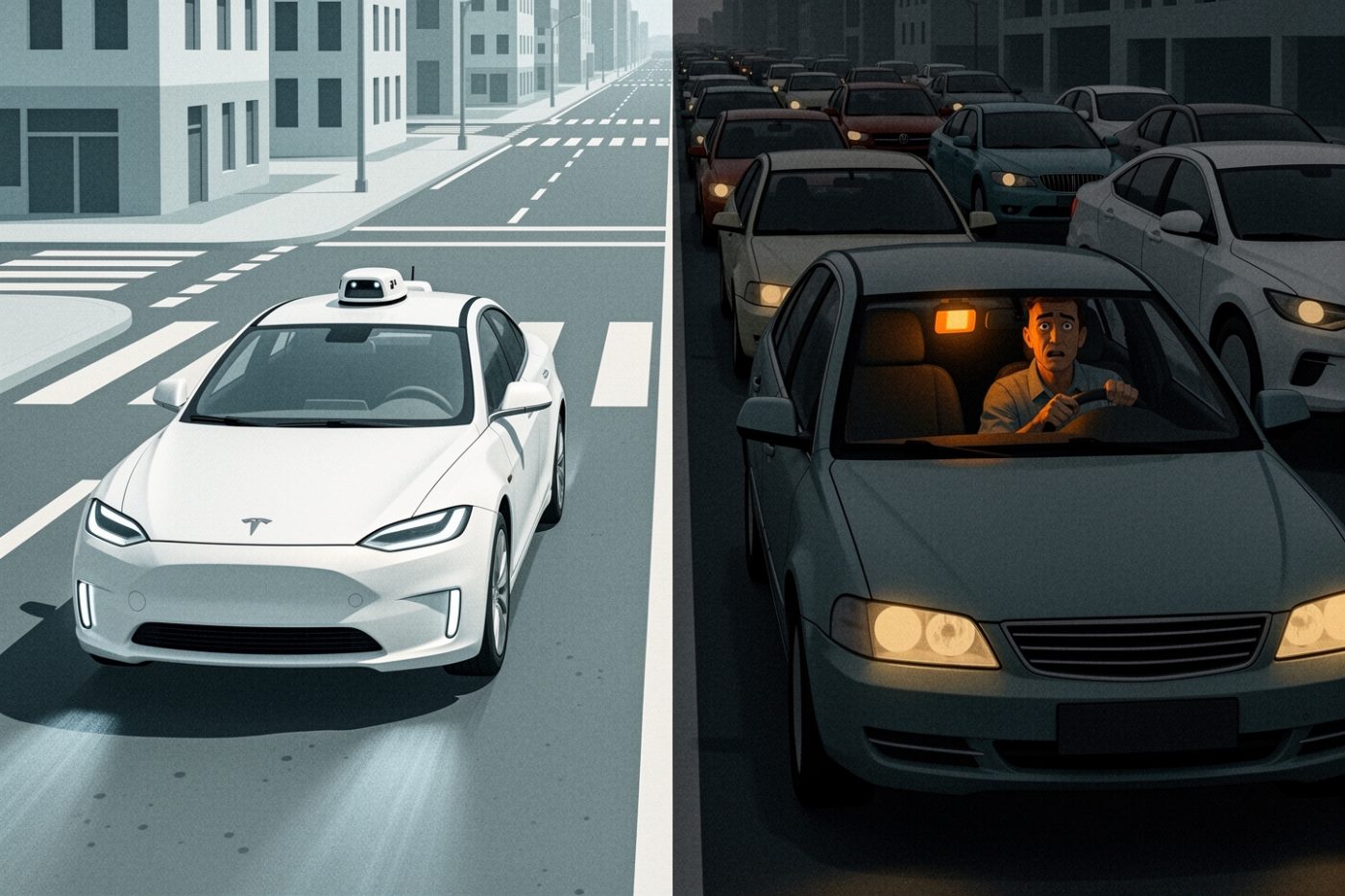
Waymo’s fleet of roughly 2,400 robotaxis now delivers about 250,000 paid rides every week across Phoenix, San Francisco, Los Angeles, and Austin, a milestone that marks the clearest signal yet that autonomous vehicles have moved from research labs into limited commercial service. The Alphabet-owned company has accumulated more than 71 million driverless miles in those four cities, adding approximately 3 million miles per month. Yet for all that progress, the industry remains caught between two competing realities: rapid technological advancement on one side, and persistent public skepticism, regulatory pressure, and unresolved safety questions on the other.
For executives, investors, and technology leaders worldwide, the state of autonomous driving in 2026 is not merely a story about cars. It is a window into how artificial intelligence is reshaping physical infrastructure, urban mobility, and supply chains. The decisions made by a handful of companies this year — on sensor design, fleet economics, and safety reporting — will influence transportation policy and investment strategies for the next decade. Understanding who is actually deploying vehicles, what the data shows, and where the risks lie is essential for anyone planning around AI-driven mobility ecosystems.
The Leaders: Waymo’s Scale vs. Tesla’s Reach
Waymo remains the dominant force in Level 4 autonomy, the category defined by full self-driving capability within geofenced areas. The company operates the largest commercial robotaxi fleet in the United States, with approximately 2,400 vehicles and a weekly paid ride volume that has grown steadily throughout 2025 and into 2026. Its safety record is the most extensively documented in the industry: Waymo reports an 88% reduction in injury-involved crashes compared to human drivers in the same operating areas. Those figures have helped Waymo secure regulatory approvals in multiple states and build a loyal, if still limited, customer base. However, the company has not disclosed profitability for its ride-hailing operations, and the cost of maintaining a fleet of sensor-laden vehicles, paying for remote monitoring, and managing city-specific operational challenges keeps the unit economics under pressure.
Tesla, by contrast, has chosen a fundamentally different path. Its Full Self-Driving (FSD) software, now at version 13.x, runs on more than 6 million vehicles globally. Those vehicles have logged a staggering 2 billion supervised miles. But the key word is supervised. Tesla’s system remains Level 2, meaning drivers must remain engaged and ready to take control at any moment. The company’s robotaxi pilot in Austin involves about 500 Cybercabs, with plans to expand to seven cities. Tesla’s cost advantage is significant: the Cybercab is estimated to cost roughly a quarter of Waymo’s Ojai model, which runs between $70,000 and $80,000. That gap stems from Tesla’s decision to rely more heavily on camera-based vision systems and less on the expensive lidar and radar sensors that Waymo uses. Tesla’s defenders argue that the company’s supervised miles are far safer than the human baseline, but independent verification remains difficult because Tesla does not release the same granular safety data that Waymo publishes.
Amazon’s Zoox occupies a smaller but notable position. The company launched its custom-built, bidirectional robotaxi in Las Vegas in late 2025 and plans to expand to San Francisco. Zoox currently operates around 150 vehicles and has logged 4.5 million driverless miles. Other players, including Motional and May Mobility, run smaller fleets in select cities. None have yet matched Waymo’s scale or Tesla’s data volume, and the gap between the leaders and the rest of the field is widening as deployment costs and regulatory hurdles mount.
Safety Data and the Limits of Progress
The safety narrative around autonomous vehicles is complex and increasingly contested. Waymo’s crash reduction statistics are impressive, but they come with important caveats. The company operates primarily in urban areas with relatively predictable road conditions and favorable weather. Its vehicles have also caused real-world disruptions. During a 2025 power outage in San Francisco linked to PG&E, Waymo vehicles blocked intersections and impeded emergency responders, raising questions about how autonomous systems handle unusual, low-probability events that fall outside their training data. Such incidents, while rare, highlight the gap between controlled testing environments and the messy reality of city streets.
More troubling are the numbers emerging from Level 2 systems, where human drivers are still expected to remain vigilant. The U.S. National Highway Traffic Safety Administration (NHTSA) has recorded at least 64 fatalities involving vehicles with Level 2 or higher automation, most of them with Tesla’s Autopilot engaged. These incidents have drawn increased regulatory scrutiny and fueled public debate about whether partial automation creates a false sense of security. Critics argue that the term “Full Self-Driving” itself is misleading for a system that still requires constant driver supervision, while supporters point to the sheer volume of miles driven as evidence that the technology is improving. The lack of standardized safety reporting across companies makes direct comparisons difficult and leaves regulators struggling to set clear benchmarks.
Public trust has not kept pace with technological progress. According to a 2026 survey by AAA, 61% of Americans say they are afraid to ride in a fully self-driving car. That figure has remained stubbornly high even as robotaxi services have expanded in major cities. For companies trying to build sustainable businesses, this trust gap is not a public relations problem to be solved with marketing. It is a structural barrier to adoption that affects everything from rider acquisition costs to insurance pricing and regulatory approval timelines. The fear is not irrational: high-profile incidents involving Cruise and Tesla have received extensive media coverage, and the opacity of how autonomous systems make decisions in critical moments leaves many consumers uneasy.
Unit Economics and the Supply Chain Reality
Despite the impressive ride volumes, no major robotaxi operator is yet profitable. Waymo’s rides generate revenue, but the cost of maintaining a fleet of sensor-laden vehicles, paying for remote monitoring, and managing city-specific operational challenges keeps the company in the red. Tesla’s approach is designed to address this problem by reducing hardware costs, but its supervised system cannot generate robotaxi revenue until regulators approve driverless operation at scale, a step that has not yet occurred. The economic challenge is not just about vehicle cost; it includes fleet maintenance, insurance, customer support, and the human oversight required even for Level 4 systems. Until these costs fall below revenue per mile, autonomous ride-hailing will remain a subsidized experiment rather than a self-sustaining business.
The supply chain implications extend far beyond the automakers themselves. NVIDIA has emerged as the dominant provider of computing platforms for autonomous vehicles, supplying the high-performance chips needed to process sensor data and run AI models in real time. This gives NVIDIA a strategic position similar to the one it holds in data center AI, and it means that any company building AVs — whether a robotaxi operator or a traditional automaker — must factor NVIDIA’s roadmap into its own product planning. For executives in adjacent industries, from logistics to insurance to urban planning, the AV supply chain is becoming a critical input to long-term strategy. The concentration of computing power in a single supplier also raises concerns about bottlenecks and pricing power as the industry scales.
Regulatory risk is also rising. Incidents involving Cruise and Tesla have prompted federal and state agencies to tighten oversight of autonomous vehicle testing and deployment. The patchwork of rules across U.S. states, European countries, and Asian markets creates significant compliance burdens for any company trying to scale globally. In China, domestic players like Baidu’s Apollo Go have expanded rapidly, but geopolitical tensions complicate any direct comparison or collaboration with Western firms. For international operators, navigating these divergent regulatory regimes adds cost and slows deployment, even as the underlying technology matures.
What Comes Next
The path to Level 5 autonomy — the ability to drive anywhere, in any conditions, without human intervention — remains distant. Expert consensus points to 2040 or later, and some researchers argue that truly generalizable self-driving may never be achieved with current deep learning approaches. What is more likely in the near term is a continuation of the current pattern: Level 4 robotaxis expanding slowly into new cities, Level 2 systems becoming more capable but still requiring oversight, and a widening gap between the companies that have real-world deployment data and those that only have prototypes. The next two to three years will be decisive in determining whether the economics of robotaxis can support sustained expansion or whether the industry will consolidate around a small number of well-capitalized players.
For international professionals, the key takeaway is that autonomous vehicles in 2026 are no longer a speculative technology but a real, if fragile, business. The unit economics are unproven, the safety data is mixed, and public trust is low. Yet the direction of travel is clear. AI is moving from software into the physical world, and transportation is its most visible testing ground. The companies that solve the cost, safety, and trust problems in the next few years will shape not just how people move, but how cities are designed, how goods are delivered, and how AI is regulated across every industry.
Sources
- Autonomous Vehicles and Self-Driving Cars in 2026
- The State of the Self-Driving Car in 2026 - by Chris Paxton
- Autonomous Vehicle Coverage
- Full Self-Driving Cars in 2026: What Every Driver Needs to Know - iDeal Auto Sales of Staten Island, NY
- Self Driving Comparison - Who Does it Best in 2026?
Written by an AI editorial process from the sources above. Errors may occur.
Newsletter
Get the AI news that matters
One short brief with the day's most important AI stories — written for professionals.
We send a confirmation link. No spam. Unsubscribe anytime.
Read next

The AI Cloud Race: Big Tech's $130B Power Play
Amazon, Microsoft, and Alphabet are spending billions to dominate AI through cloud infrastructure, reshaping global tech, security, and market dynamics.
19 Sep 2026
AI Inference Market to Hit $255B by 2030
Global demand for real-time AI decision-making drives explosive growth in inference infrastructure, with NVIDIA, Intel, and Siemens Healthineers leading diverse applications.
18 Sep 2026
Autonomous AI Agents Become Core Enterprise Infrastructure in 2026
The market for autonomous AI agents is projected to surge from $7.92 billion in 2025 to $236.03 billion by 2034, as enterprises shift from experimentation to governing systems that perform operational work.
14 Sep 2026