Startups Launch Targeted AI Tools for Real-World Use
A new wave of startups is delivering practical, domain-specific AI solutions for healthcare, marketing, and small business operations.
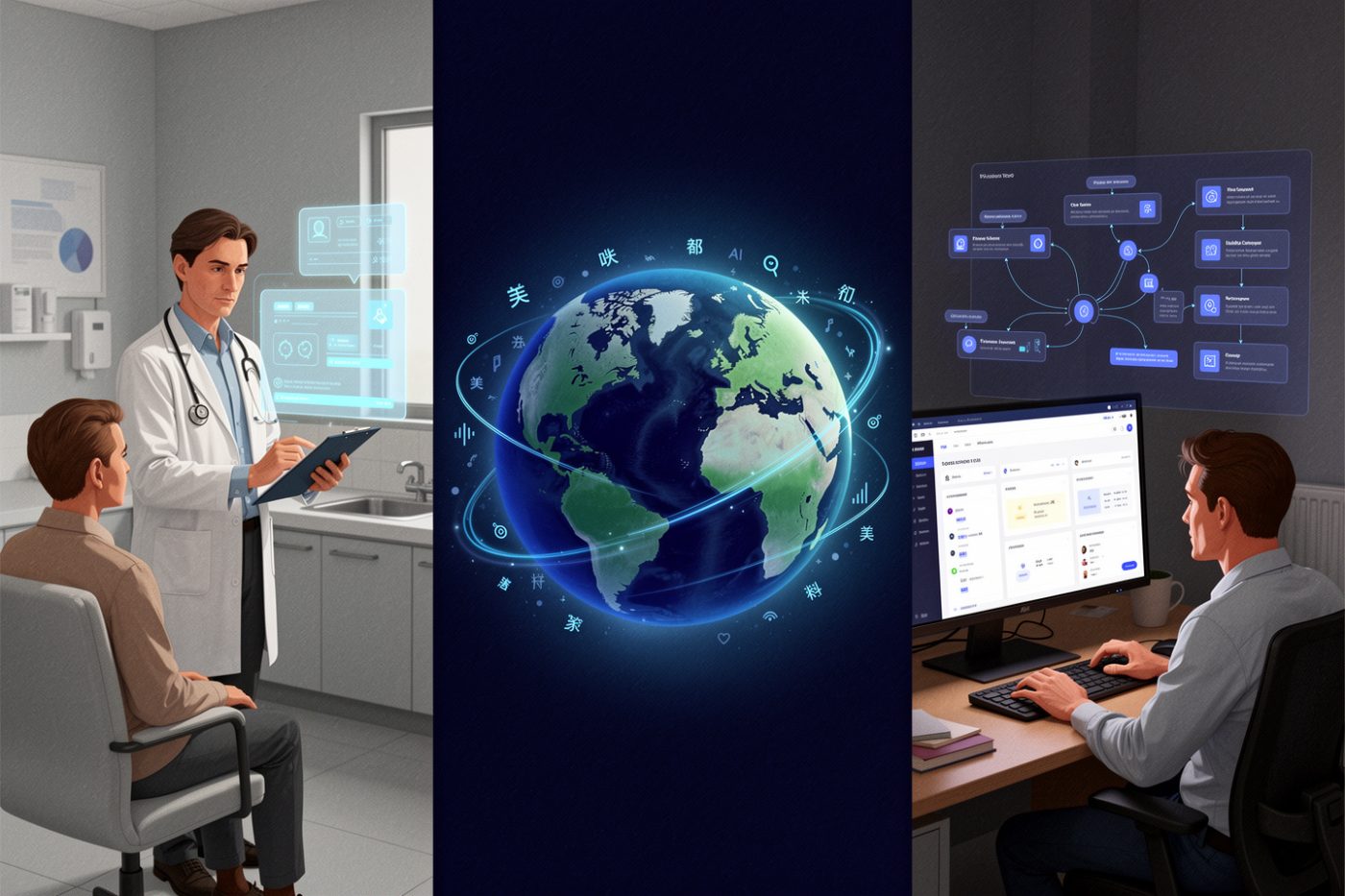
In April 2026, a wave of AI-driven startups launched products that signal a shift toward more accessible, domain-specific artificial intelligence tools tailored for small businesses, creative professionals, and niche technical workflows. Unlike previous waves dominated by large language models or general-purpose AI assistants, this month’s crop emphasizes precision, integration, and usability—particularly for non-technical users. Among the most notable entries are Softr’s AI-powered no-code automation suite, ThinkLabs AI’s clinical decision support system for primary care providers, and Rocket’s real-time multilingual content engine. These launches reflect a maturing AI ecosystem where startups are no longer chasing scale for its own sake but are instead solving concrete operational problems in healthcare, marketing, and enterprise software.
This shift matters because it marks the beginning of AI’s transition from experimental novelty to embedded utility. While tech giants continue refining foundational models, startups are now building the middleware layer—products that make AI actionable for the 90% of organizations that lack data science teams. According to a report by Crescendo.ai, early adopters of these tools have seen up to a 40% reduction in time spent on routine documentation and a 30% increase in content output quality. As AI becomes less about raw capability and more about contextual relevance, these startups are positioning themselves as essential enablers of digital transformation in underserved markets.
Softr AI: No-Code Automation for Small Enterprises
Softr, known for its no-code website builder, unveiled Softr AI—a suite of automation tools that allows users to generate workflows, draft client communications, and extract insights from databases using plain language prompts. The product integrates directly with Airtable, Google Workspace, and Stripe, enabling small businesses to automate invoicing, customer onboarding, and project tracking without writing a single line of code.
“We’re not building another chatbot,” said CEO Amir Khella in a statement. “We’re giving teams the ability to turn their existing data into automated actions.” For example, a freelance design agency using Softr AI can now set up a trigger where, upon receiving a signed contract in Google Docs, the system automatically creates a project timeline, sends a welcome email, and logs the client in their CRM.
The product leverages a fine-tuned variant of Llama 3.1, optimized for low-latency responses and high accuracy in business logic interpretation. It operates on a usage-based pricing model starting at $29 per month, making it accessible to solopreneurs and micro-teams. Early feedback from beta users, shared via LinkedIn, highlights a 50% reduction in administrative overhead, particularly among consultants and agencies.
ThinkLabs AI: Bridging the Gap in Primary Care
ThinkLabs AI, a Boston-based health tech startup, launched Clara Clinician—a real-time AI assistant designed to support primary care physicians during patient consultations. Unlike general AI tools, Clara is trained exclusively on de-identified clinical notes, medical guidelines, and drug interaction databases, with compliance built for HIPAA and GDPR standards.
During a live consultation, Clara listens (via opt-in audio capture) and generates differential diagnoses, flags potential medication conflicts, and drafts visit summaries aligned with insurance coding requirements. In trials conducted at three community health centers in early 2026, physicians using Clara reduced documentation time by an average of 18 minutes per day and improved diagnostic accuracy for chronic conditions like diabetes and hypertension by 12%, according to internal metrics.
“The goal isn’t to replace doctors,” said Dr. Elena Martinez, ThinkLabs’ chief medical officer. “It’s to give them a cognitive partner that handles the clerical load so they can focus on the patient.” The system runs on-device to ensure data privacy, with only anonymized metadata sent to the cloud for model improvement.
ThinkLabs is currently in talks with regional health networks in the U.S. and Germany, and has secured $15 million in Series A funding led by HealthQuad. The product is available by invitation only, with full commercial rollout expected in Q3 2026.
Rocket: Real-Time Multilingual Content at Scale
Rocket, a stealth-mode startup founded by ex-Meta and DeepL engineers, launched its first product: an AI engine that generates and translates marketing content across 32 languages with cultural nuance and brand voice preservation. The platform targets e-commerce brands and digital agencies that need to localize campaigns quickly without relying on human translators for first drafts.
What sets Rocket apart is its “tone mapping” technology, which allows users to define brand personas—such as “friendly but professional” or “youthful and irreverent”—and ensures those tones are consistently applied across all languages. In a benchmark test shared with Crescendo.ai, Rocket outperformed Google Translate and DeepL in maintaining idiomatic expressions and brand-specific terminology in Spanish, Japanese, and Arabic.
“Most translation tools focus on literal accuracy,” said CTO Linh Nguyen. “We focus on emotional resonance. A slogan that works in Berlin should feel just as compelling in Bangkok.” The system uses a hybrid architecture combining a distilled version of Mistral 3 with a proprietary cultural adaptation layer trained on regional media, social trends, and consumer behavior data.
Rocket’s API is already integrated into Shopify and HubSpot, and early clients include a sustainable fashion brand expanding into Latin America and a fintech startup launching in Southeast Asia. Pricing starts at $199 per month for up to 50,000 words. The company has raised $22 million in seed funding from Index Ventures and LocalGlobe.
Market Implications and Competitive Landscape
The April 2026 launches underscore a broader trend: AI innovation is decentralizing. While Google, Microsoft, and OpenAI continue to dominate headlines with larger models and multimodal capabilities, startups are capturing value by operating in the “last mile” of AI deployment—where technology meets daily workflows.
According to a July 2026 blog post from Google, even the largest AI players are recognizing this shift. “The future of AI isn’t just in the model,” wrote Google’s AI lead, “it’s in the products that make it useful.” The company announced new partnerships with no-code platforms and health tech firms, suggesting a strategic pivot toward enabling third-party innovation rather than controlling the entire stack.
Still, challenges remain. Regulatory scrutiny is increasing, particularly around AI in healthcare and automated decision-making. ThinkLabs AI, for instance, must navigate FDA guidelines for clinical software, while Rocket faces questions about bias in cross-cultural content generation. Additionally, the reliance on open-source models like Llama and Mistral introduces dependency risks—if those models change licensing terms or update architectures, downstream products may need significant re-engineering.
Investor interest, however, remains strong. Global venture funding for AI startups reached $8.3 billion in Q1 2026, up 22% year-over-year, with a notable increase in pre-seed and seed-stage deals, per data from PitchBook cited in Tech Startups’ April 6 report.
Sources
- AI Product Launches News | April, 2026 (STARTUP EDITION)
- Artificial intelligence - Wikipedia
- Recent AI Product Launches - LinkedIn
- The Latest AI News and Breakthroughs That Matter Most
- The latest AI news we announced in July 2026
Written by an AI editorial process from the sources above. Errors may occur.
Newsletter
Get the AI news that matters
One short brief with the day's most important AI stories — written for professionals.
We send a confirmation link. No spam. Unsubscribe anytime.
Read next

Gemini's New AI Model Transforms Photo Editing with Multi-Turn Control
Google's Gemini 2.5 Flash Image enables precise, context-aware edits across multiple steps, advancing creative workflows for professionals.
27 Sep 2026
Autonomous AI Agents: The Rise of Digital Workforce
How self-reasoning AI systems are transforming business workflows and redefining automation across industries.
26 Sep 2026
Adobe Launches AI Video Generation in Creative Cloud
Adobe unveils Firefly Video Model and faster image generation, embedding AI deeply into professional creative workflows.
26 Sep 2026