Self-Driving in 2026: Robotaxis Scale While Consumer Cars Still Need Drivers
Waymo and Baidu expand driverless fleets, but no consumer vehicle is fully automated. The gap between Level 4 services and Level 2 cars defines autonomy in 2026.
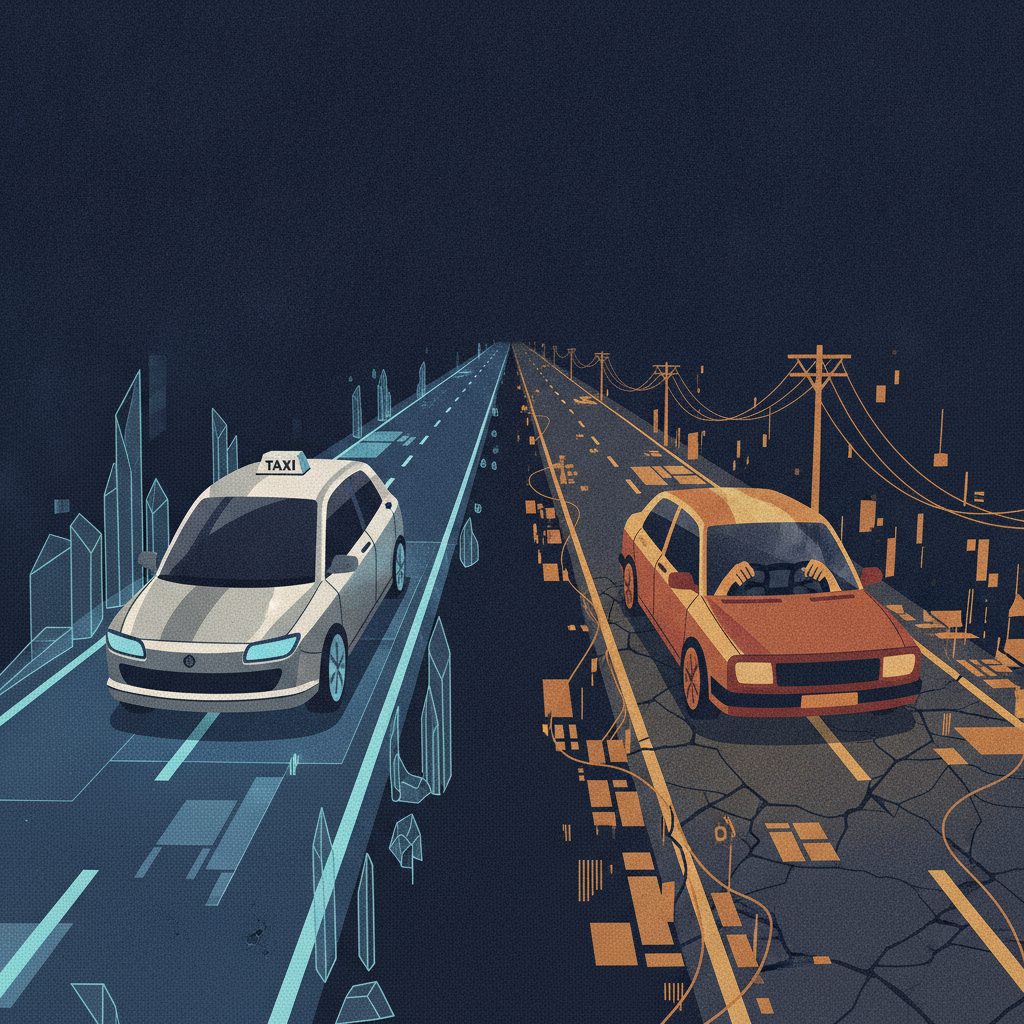
In 2026, the self-driving industry has crossed a critical threshold: robotaxis are no longer pilot projects, and autonomous trucks are moving freight on public highways, yet the car in a consumer’s driveway remains firmly under human supervision. Waymo now provides more than 500,000 paid rides per week across 14 U.S. metropolitan areas, while the U.S. National Highway Traffic Safety Administration (NHTSA) maintains that no vehicle sold to consumers is fully automated. That gap between commercial fleets and personal vehicles defines the state of autonomy this year.
The shift matters because the global autonomous vehicle market is now valued at USD 2.6 trillion, according to recent industry analyses. For executives and founders, the move toward Mobility-as-a-Service and autonomous logistics is creating enormous commercial opportunities. At the same time, new regulatory frameworks are increasing accountability for operators, making safety and compliance central to any scaling strategy.
The Two-Track Reality: Level 4 Fleets and Level 2 Consumer Systems
The industry has split into two distinct tracks. On one side are Level 4 robotaxis, which can operate without a human driver inside a defined geographic area. On the other are advanced driver-assistance systems (ADAS) sold to consumers, which remain at Level 2 automation and require full driver attention. Tesla’s “Full Self-Driving (Supervised)” system, despite its name, is classified as Level 2 by regulators.
“No vehicle sold to consumers is fully automated,” the NHTSA states, underscoring the gap between marketing language and regulatory reality.
Level 3 systems, which allow eyes-off driving in limited conditions, have been offered briefly by Mercedes, BMW, and Honda but are not widely available. The practical result is that the most advanced hands-off experiences today are found in commercial robotaxi fleets, not in privately owned cars. Tesla has said it aims to bring unsupervised Full Self-Driving to consumer vehicles by late 2026, but that remains a target rather than a current capability.
The Numbers Behind Commercial Deployment
Waymo, owned by Alphabet, is the dominant U.S. robotaxi operator. Its fleet of more than 4,000 vehicles serves 14 metro areas and delivers over 500,000 paid rides each week. Amazon’s Zoox operates a smaller fleet of about 100 purpose-built, bidirectional robotaxis in Las Vegas and San Francisco, with plans to expand. Tesla has begun limited driverless service in Austin with a small fleet, scaling its Cybercab robotaxi offering.
In China, Baidu’s Apollo Go delivered 3.2 million fully driverless rides in the first quarter of 2026. The company has launched commercial services in Dubai and is planning expansion in Europe through partnerships with Uber and Lyft. This international push signals that robotaxi competition is no longer confined to Silicon Valley or Shenzhen.
Autonomous trucking is also advancing. Aurora has validated a 1,000-mile driverless route from Phoenix to Fort Worth, operating beyond human hours-of-service limits. The company aims to have more than 200 driverless trucks on the road by the end of the year, working with logistics partners to move freight without a human behind the wheel.
Regulation and Safety: California’s New Enforcement Model
Regulators are beginning to catch up with deployment. From July 1, 2026, new California rules allow law enforcement to issue traffic violations directly to autonomous vehicle companies, rather than to a human driver. The California DMV and NHTSA remain critical oversight bodies, and the new enforcement mechanism increases operator accountability in the largest U.S. testing ground for robotaxis.
Safety data offers a mixed picture. Waymo’s fleet had 68% fewer police-reportable crashes than human drivers, according to the company’s analysis. But recent incidents, including a Waymo vehicle hitting a child near a school, highlight persistent edge-case challenges. Consumer trust remains fragile, with concerns over cybersecurity and unpredictable behavior in complex conditions continuing to shape public perception.
Market Implications and the Road Ahead
The commercial opportunity is shifting from selling cars to selling miles. Mobility-as-a-Service models allow operators to generate recurring revenue from robotaxi fleets, while autonomous trucking promises to reshape logistics by removing human hours-of-service constraints. For investors and operators, the key question is no longer whether autonomy works in controlled settings, but whether it can scale profitably without eroding public trust.
The next 12 to 18 months will test that proposition. Waymo and Baidu are expanding into new cities and countries, Zoox is moving beyond its initial two markets, and Aurora is pushing toward a larger driverless truck fleet. At the same time, Tesla’s consumer autonomy ambitions could blur the line between Level 2 and Level 4 if unsupervised Full Self-Driving reaches private owners. But until regulators certify such systems for eyes-off operation in consumer vehicles, the industry’s most concrete progress will remain in geofenced fleets and freight corridors.
Sources
- State of Self-Driving in 2026 and Beyond
- The Autonomous Driving Tech Industry 2026 - Shayaike Hassan
- Autonomous Vehicles and Self-Driving Cars in 2026
- The State of the Self-Driving Car in 2026 - by Chris Paxton
- Full Self-Driving Cars in 2026: What Every Driver Needs to Know - iDeal Auto Sales of Staten Island, NY
Written by an AI editorial process from the sources above. Errors may occur.
Newsletter
Get the AI news that matters
One short brief with the day's most important AI stories — written for professionals.
We send a confirmation link. No spam. Unsubscribe anytime.
Read next

The AI Cloud Race: Big Tech's $130B Power Play
Amazon, Microsoft, and Alphabet are spending billions to dominate AI through cloud infrastructure, reshaping global tech, security, and market dynamics.
19 Sep 2026
AI Inference Market to Hit $255B by 2030
Global demand for real-time AI decision-making drives explosive growth in inference infrastructure, with NVIDIA, Intel, and Siemens Healthineers leading diverse applications.
18 Sep 2026
Autonomous AI Agents Become Core Enterprise Infrastructure in 2026
The market for autonomous AI agents is projected to surge from $7.92 billion in 2025 to $236.03 billion by 2034, as enterprises shift from experimentation to governing systems that perform operational work.
14 Sep 2026