Robotaxis Scale Up While Safety Incidents Test Public Trust
Waymo hits 500,000 weekly rides and Pony.ai cuts costs, but a Zoox recall and a fatal collision with a San Francisco cat reveal the industry's fragile social license.
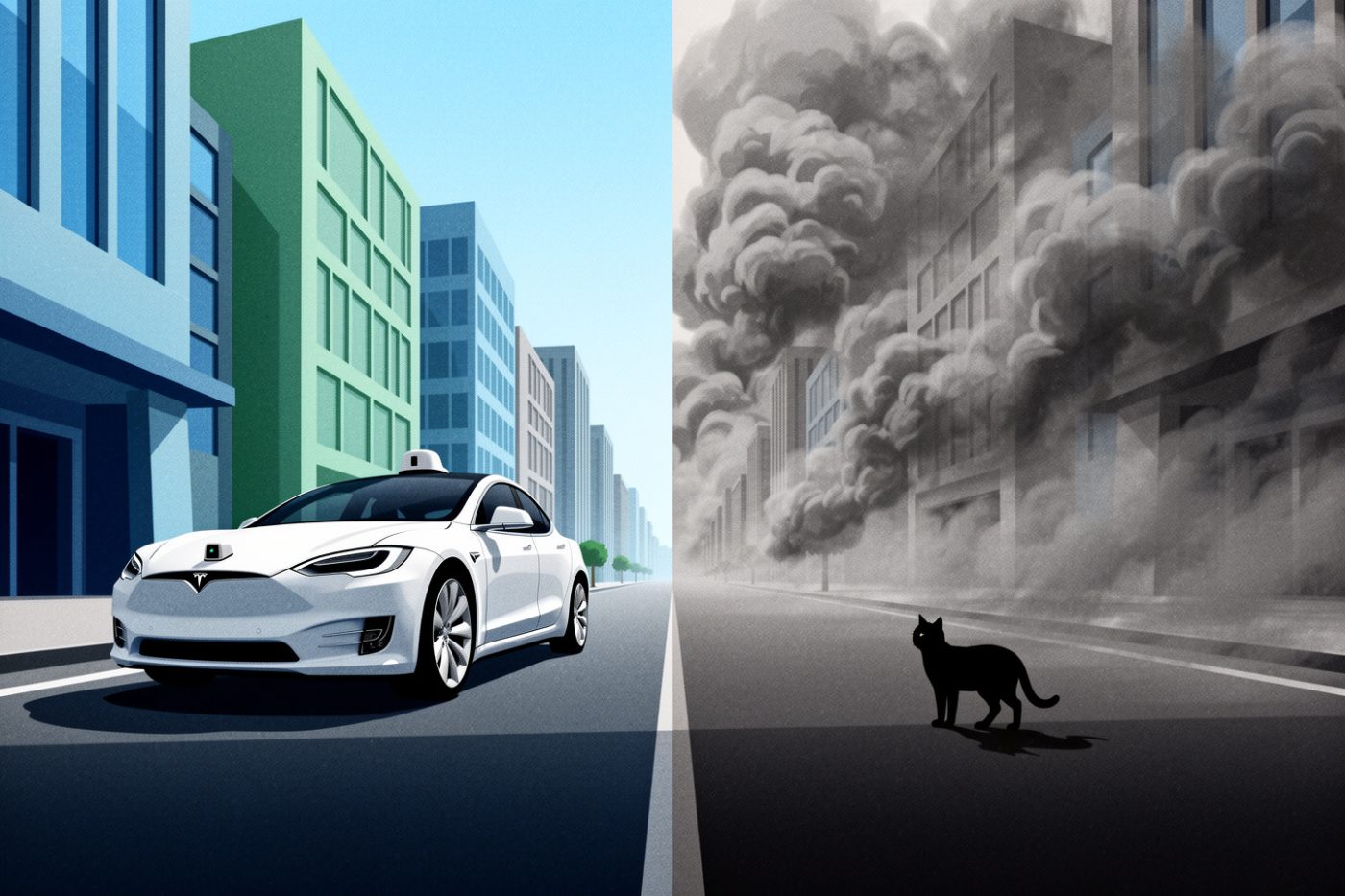
The autonomous vehicle industry is entering a period of stark contrasts in 2026. On one side, commercial robotaxi fleets are scaling at an unprecedented pace, with Waymo now providing 500,000 paid rides each week across ten U.S. cities, up from 400,000 earlier in the year. On the other, a full-fleet recall at Amazon-owned Zoox over a smoke-detection flaw and a fatal collision involving a Waymo vehicle and a beloved San Francisco cat have thrust safety questions back into the spotlight. The global market, valued at USD 273.75 billion in 2025, is projected to surge to USD 5,439.46 billion by 2035, growing at a compound annual rate of 34.84 percent, according to Precedence Research. But the path to that future is proving far more complex than early evangelists predicted.
For executives, investors, and urban planners worldwide, the current moment matters because it reveals a fundamental tension: the technology is maturing fast enough to generate real revenue and even unit-level profitability in some Chinese cities, yet it still struggles with edge cases that can erode public trust overnight. The decisions made by regulators, manufacturers, and technology providers over the next two years will likely determine whether autonomous driving becomes a ubiquitous utility or remains a patchwork of restricted deployments.
Scale and Profitability Are No Longer Theoretical
The most significant commercial signal comes from Waymo, the Alphabet subsidiary that has long been the bellwether for U.S. robotaxi ambitions. The company reached 500,000 paid weekly trips in March 2026, up from 400,000 earlier in the year. That trajectory suggests accelerating adoption in the ten cities where it operates, though Waymo has not disclosed revenue figures or per-mile economics. The scale is impressive, but it also magnifies the consequences of any failure, as the company discovered in October 2025 when one of its vehicles struck and killed KitKat, a well-known bodega cat in San Francisco’s Mission District, on October 27. The incident, while involving an animal rather than a human, became a flashpoint for public frustration with autonomous vehicles operating in dense urban environments. Waymo acknowledged the incident and stated that it was reviewing its detection systems for small animals, but the company has not announced any specific technical changes.
In China, Pony.ai is demonstrating that cost reduction can be as important as ride volume. The company reported a 70 percent reduction in bill-of-materials costs for its Gen-7 Robotaxi’s autonomous driving kit compared to the previous generation. Total vehicle cost is expected to fall below RMB 230,000, or roughly USD 33,000. That figure is striking because it approaches the price of a conventional mid-range car, potentially removing one of the biggest barriers to fleet expansion. Pony.ai achieved city-level unit economics breakeven in Guangzhou in November 2025 and in Shenzhen in March 2026. Its Gen-7 platform uses 34 sensors, including 9 LiDAR units, and is built entirely on automotive-grade components. The company has not yet disclosed whether these economics hold when accounting for remote monitoring, fleet maintenance, and insurance costs, but the milestones are notable for an industry that has burned through billions of dollars in venture capital.
Safety Incidents Test Regulatory Patience
The commercial momentum is colliding with a series of safety incidents that regulators are no longer willing to treat as isolated anomalies. In July 2026, Zoox recalled its entire fleet of 105 autonomous vehicles after one of its robotaxis entered a smoke-obscured fire scene in Las Vegas on June 20. The vehicle’s software failed to detect heavy smoke, potentially impeding emergency responders who were already operating at the scene. The National Highway Traffic Safety Administration (NHTSA) cited a “clear pattern” of autonomous vehicles interfering with first responders, language that signals a shift from cautionary guidance toward enforcement-oriented scrutiny.
NHTSA has also issued warnings about autonomous vehicles blocking emergency scenes and is investigating multiple incidents involving both Waymo and Zoox. The Zoox recall is particularly significant because it was not triggered by a collision or injury but by a failure to recognize a hazardous environmental condition that human drivers would typically avoid. That distinction matters for the industry’s broader safety narrative. A vehicle that cannot detect smoke may also struggle with other visually ambiguous hazards, such as dust storms, chemical plumes, or dense fog. Zoox has not disclosed how long the software fix will take, nor whether the recall will delay its plans to expand beyond its current test markets.
The KitKat incident, while less severe in regulatory terms, has had an outsized impact on public perception. The cat was a fixture in its San Francisco neighborhood, and its death generated widespread media coverage and social media outrage. The episode illustrates a challenge that goes beyond engineering: even when autonomous vehicles perform as designed, they can still produce outcomes that communities find unacceptable. That gap between technical compliance and social acceptance is becoming a central issue for companies seeking to expand robotaxi services into new cities.
Level 3 Autonomy Faces a Reckoning
While robotaxis dominate headlines, the market for personally owned vehicles with Level 3 autonomy — where the car can drive itself under specific conditions but a human must be ready to take over — is showing signs of retreat. BMW received approval for Level 3 autonomous driving in Germany in 2023, becoming one of the first automakers to offer the capability in a production vehicle. But in 2026, the company discontinued its “Personal Pilot L3” system, citing limited use cases and high costs. BMW is now shifting its focus to enhanced Level 2+ systems, which require continuous driver supervision but are less expensive to deploy and less legally complex to certify.
That decision reflects a broader industry hesitation about the value proposition of Level 3 autonomy. The technology works only in narrowly defined conditions, such as slow-moving traffic on divided highways, and the handoff between machine and human driver remains a source of both legal and practical risk. If a driver is not paying attention when the system requests a takeover, the result can be worse than either fully manual or fully autonomous driving. Several other automakers, including Mercedes-Benz and Honda, continue to offer limited Level 3 systems in select markets, but BMW’s retreat suggests that the near-term commercial opportunity lies elsewhere. Critics argue that Level 3 autonomy is impractical due to these narrow use cases, while others maintain that full autonomy will ultimately save lives by eliminating human error. The disagreement is not academic; it shapes where automakers allocate billions of dollars in research and development.
Readiness Rankings and the Global Competitive Landscape
The United States currently leads in autonomous vehicle readiness with a score of 24.75, followed closely by Sweden at 24.73 and the United Kingdom at 23.99, according to market research compiled by Market.us. These rankings incorporate factors such as regulatory frameworks, infrastructure investment, and public acceptance. The narrow margins among the top three indicate that no single country has established a decisive advantage, and the situation could shift quickly as new regulations take effect. North America’s dominance in readiness contrasts with China’s lead in market share, a divergence that reflects different approaches to deployment speed versus regulatory caution.
China, despite not topping the readiness index, is arguably the most important market for commercial deployment. Pony.ai’s breakeven milestones in Guangzhou and Shenzhen are not just company-specific achievements; they demonstrate that robotaxi economics can work in dense, complex urban environments where labor costs for traditional ride-hailing are already low. If Chinese operators can achieve profitability at scale, they will have a template that can be exported to other markets, particularly in Southeast Asia and the Middle East, where regulatory environments are often more permissive than in Europe or North America. The cost reductions achieved by Pony.ai signal a path to profitability that Western competitors have yet to match, while Zoox’s recall underscores the importance of fail-safe systems that can handle rare but critical scenarios.
The next phase of the autonomous vehicle story will be defined by whether the industry can maintain its commercial momentum while addressing the safety and trust deficits that incidents like the Zoox recall and the KitKat collision have exposed. Pony.ai’s cost reductions and Waymo’s ride volumes prove that the technology can scale and generate revenue. But the regulatory scrutiny now facing the industry suggests that the era of forgiving experimentation is over. Companies that can demonstrate rigorous safety validation alongside unit economics will be positioned to capture a disproportionate share of the multi-trillion-dollar market that analysts project. Those that cannot may find themselves sidelined by regulators, insurers, and the very public they hope to serve. For specialists in mobility, logistics, and urban planning, the data shows that scalability and safety must go hand in hand to achieve long-term success.
Sources
- Self-driving car
- In China, self-driving cars can park, change lanes and drive like humans
- Waymo Self-Driving Car Kills Beloved San Francisco Bodega Cat
- How self-driving cars will change cities: The view from CES - PitchBook
- Zoox recalls self-driving cars because they may not detect smoke - The Economic Times
Written by an AI editorial process from the sources above. Errors may occur.
Newsletter
Get the AI news that matters
One short brief with the day's most important AI stories — written for professionals.
We send a confirmation link. No spam. Unsubscribe anytime.
Read next

The AI Cloud Race: Big Tech's $130B Power Play
Amazon, Microsoft, and Alphabet are spending billions to dominate AI through cloud infrastructure, reshaping global tech, security, and market dynamics.
19 Sep 2026
AI Inference Market to Hit $255B by 2030
Global demand for real-time AI decision-making drives explosive growth in inference infrastructure, with NVIDIA, Intel, and Siemens Healthineers leading diverse applications.
18 Sep 2026
Autonomous AI Agents Become Core Enterprise Infrastructure in 2026
The market for autonomous AI agents is projected to surge from $7.92 billion in 2025 to $236.03 billion by 2034, as enterprises shift from experimentation to governing systems that perform operational work.
14 Sep 2026