Robotaxi Economics Are Finally Shifting—But Safety Blind Spots Persist
Falling hardware costs and NVIDIA-led alliances are making autonomous ride-hailing viable, yet incidents like the Zoox recall show emergency-scene perception remains a critical unresolved bottleneck.
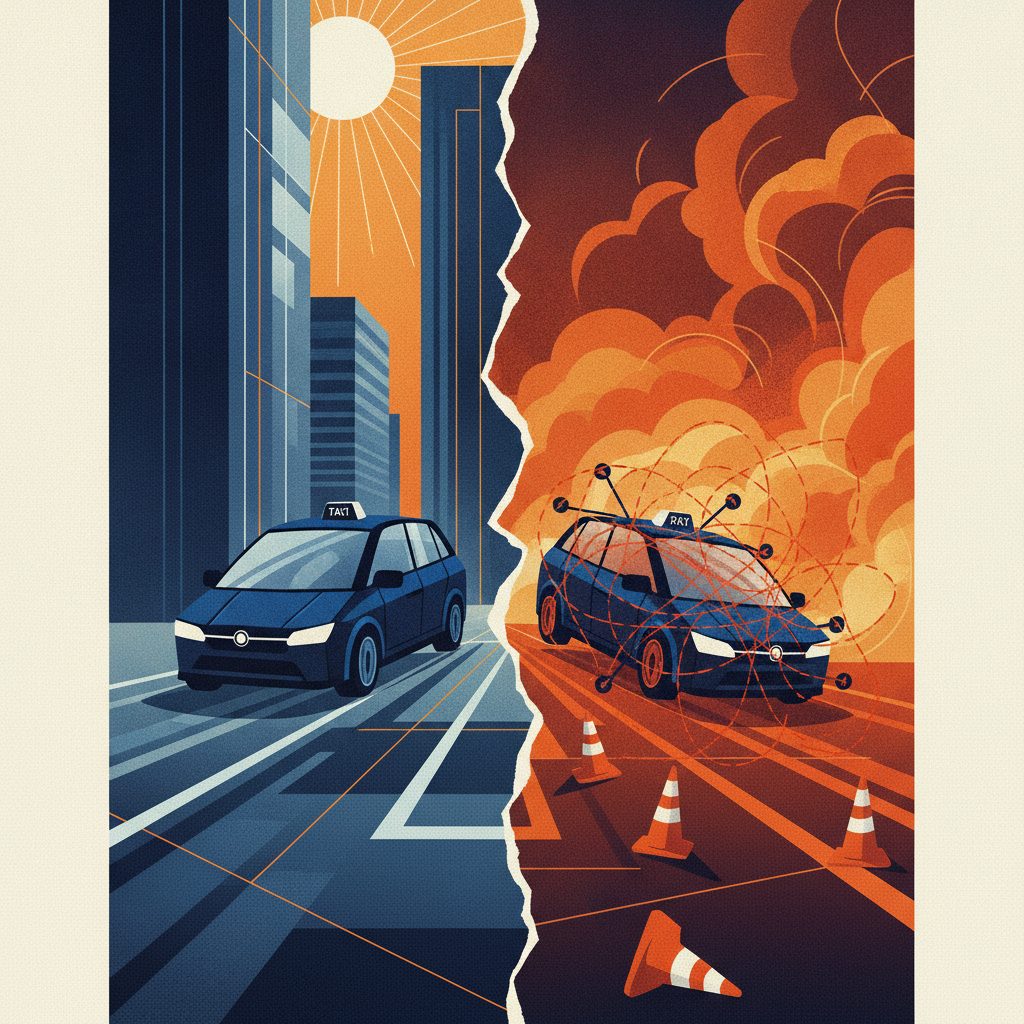
The race to deploy robotaxis at scale is accelerating, driven by a sharp decline in hardware costs and a new wave of strategic alliances centered on NVIDIA’s computing platform. In a landmark partnership announced this year, NVIDIA, Uber, and automakers Stellantis, Lucid, and Mercedes-Benz committed to building a global network of Level 4 autonomous vehicles, with Uber alone planning to field 100,000 robotaxis starting in 2027. The collaboration pairs NVIDIA’s DRIVE AGX Hyperion 10 platform with a joint AI data factory built on the NVIDIA Cosmos foundation model platform, creating a vertically integrated pipeline from simulation to street deployment.
Yet the same month that this ambitious rollout was unveiled, Amazon-owned Zoox issued a software recall for its entire fleet of 105 vehicles after one of its robotaxis drove directly into a smoke-obscured fire scene in Las Vegas on June 20, 2026. The contrast captures the current state of autonomous driving: the technology is maturing fast enough to justify enormous capital commitments, but real-world safety validation remains a stubborn, unresolved bottleneck. For executives and investors, the message is clear—robotaxis are nearing economic viability, but the path to mass adoption still runs through regulatory scrutiny and edge-case engineering.
The Economics Are Finally Shifting
For years, the biggest obstacle to robotaxi deployment was not software but hardware cost. Early autonomous vehicle prototypes carried sensor suites costing hundreds of thousands of dollars, making any business model untenable. That is changing rapidly. According to industry data, semi-solid-state lidar costs have halved twice since 2022, a trajectory that has fundamentally altered unit economics. Pony.ai, the Chinese autonomous driving company, now reports that its seventh-generation robotaxi hardware costs just $40,000 per vehicle—down from approximately $200,000 for earlier Waymo models.
This cost compression is not limited to lidar. NVIDIA’s DRIVE AGX Thor chip, based on the company’s Blackwell architecture, delivers more than 2,000 FP4 teraflops of compute in a single automotive-grade system-on-chip. That level of processing power, once confined to data center GPUs, now fits inside a vehicle and can handle the real-time sensor fusion, path planning, and decision-making required for complex urban environments. When combined with falling sensor prices, the total bill of materials for a robotaxi is approaching a range where ride-hailing economics start to make sense at scale.
AI is also compressing development timelines. Digital twin simulation allows engineers to test millions of edge cases without physical vehicles, while natural language interfaces let teams interrogate why a vehicle made a particular decision in a given scenario. These tools reduce the cost of iteration and shorten the gap between software releases, which is critical when fleets are expanding across multiple cities and regulatory jurisdictions. The result is a faster feedback loop between real-world incidents and software updates, a capability that will be essential as operators scale from hundreds to tens of thousands of vehicles.
Safety Incidents Expose a Persistent Blind Spot
The Zoox recall in July 2026 highlighted a specific and recurring failure mode: autonomous vehicles struggling to interpret emergency scenes. According to the National Highway Traffic Safety Administration, the Zoox vehicle drove into heavy smoke from a fire on June 20 in Las Vegas because its perception stack failed to recognize smoke as a hazard. The company issued a software update to address the deficiency, but the incident was not isolated.
NHTSA has warned multiple autonomous vehicle developers, including Waymo, about repeated cases of vehicles interfering with first responders. The agency has documented instances where robotaxis failed to recognize smoke, road flares, and traffic cones placed by emergency personnel. Jonathan Morrison, head of NHTSA, described the problem bluntly: “This is a functional insufficiency, not a rare edge case.” The statement signals a shift in regulatory posture. Rather than treating such failures as acceptable outliers in a probabilistic system, regulators are beginning to demand that autonomous vehicles handle emergency scenes as a core competency, not an exception.
The challenge is partly architectural. Most perception systems are trained primarily on normal driving data—clear roads, visible lane markings, predictable traffic patterns. Emergency scenes are chaotic, low-visibility, and often involve objects placed in unconventional positions. Smoke, in particular, is difficult for lidar and camera-based systems to classify correctly because it lacks a stable geometric shape and can obscure other objects unpredictably. Solving this requires not just more data, but specifically curated datasets of emergency scenarios, which are expensive to collect and ethically complex to simulate. The Zoox incident underscores that even well-funded developers with mature stacks can miss these scenarios, and that regulatory pressure will likely intensify as deployments grow.
The Partnership Landscape Is Consolidating
The NVIDIA-Uber-automaker alliance is significant not just for its scale but for its structure. Uber brings ride-hailing demand and operational expertise; Stellantis, Lucid, and Mercedes-Benz bring manufacturing capacity and vehicle platforms; NVIDIA supplies the compute backbone and simulation infrastructure. The joint AI data factory is designed to continuously ingest real-world driving data from the fleet, retrain models, and push updates back to vehicles—a closed loop that accelerates improvement as the fleet grows.
This model mirrors what has worked in other AI domains, where data flywheels create compounding advantages for early movers. A fleet of 100,000 vehicles operating daily would generate an enormous volume of edge-case data, far beyond what any single automaker could collect through test programs. The partnership also signals that automakers are increasingly willing to outsource the autonomous driving stack rather than build it in-house, a reversal from the early 2020s when several major manufacturers pursued proprietary systems. Stellantis, Lucid, and Mercedes-Benz each bring distinct regional strengths and vehicle platforms, allowing the alliance to target multiple markets simultaneously without duplicating core development efforts.
For NVIDIA, the strategy extends its data center dominance into the automotive sector. The DRIVE platform is not just a chip sale; it is an entry point into a recurring revenue stream from software, simulation, and data processing services. As robotaxi fleets scale, the compute demand for training and simulation grows in tandem, creating a multiplier effect that benefits NVIDIA’s core business. The Cosmos foundation model platform, which underpins the joint AI data factory, is designed to generate synthetic training data and simulate rare scenarios at scale, reducing the cost and time required to improve perception models. This positions NVIDIA not merely as a supplier but as an infrastructure provider for the entire robotaxi ecosystem.
What Comes Next
The next 18 to 24 months will be decisive. Uber’s 2027 deployment target is aggressive, and meeting it will require clearing regulatory hurdles in multiple markets simultaneously. The Zoox recall and NHTSA’s warnings suggest that safety validation will not be a rubber stamp. Developers will need to demonstrate robust performance in emergency scenarios, not just in controlled testing environments, before regulators grant the permits needed for large-scale commercial operation. The fact that NHTSA has already issued warnings to multiple developers indicates that the agency is watching closely and will not hesitate to act if incidents continue.
Cost curves are moving in the right direction, and the technology is improving rapidly. But the gap between a compelling demo and a safe, reliable service operating across thousands of vehicles in unpredictable real-world conditions remains substantial. The companies that close that gap first—by solving the emergency-scene problem and building trust with regulators—will be positioned to capture a market that could reshape urban transportation. Those that rush to deploy without addressing known failure modes risk costly recalls, regulatory crackdowns, and a loss of public confidence that could set the entire industry back years.
Sources
- Robotaxis, Autonomous Vehicles & Self-Driving Cars | NVIDIA
- What is AI in Self-Driving Cars: How They Work in 2026
- Big reduction in costs could see explosion of robot car services
- Autonomous vehicles' blind spot
- Zoox recalls self-driving cars because they may not detect smoke - The Economic Times
Written by an AI editorial process from the sources above. Errors may occur.
Newsletter
Get the AI news that matters
One short brief with the day's most important AI stories — written for professionals.
We send a confirmation link. No spam. Unsubscribe anytime.
Read next

The AI Cloud Race: Big Tech's $130B Power Play
Amazon, Microsoft, and Alphabet are spending billions to dominate AI through cloud infrastructure, reshaping global tech, security, and market dynamics.
19 Sep 2026
AI Inference Market to Hit $255B by 2030
Global demand for real-time AI decision-making drives explosive growth in inference infrastructure, with NVIDIA, Intel, and Siemens Healthineers leading diverse applications.
18 Sep 2026
Autonomous AI Agents Become Core Enterprise Infrastructure in 2026
The market for autonomous AI agents is projected to surge from $7.92 billion in 2025 to $236.03 billion by 2034, as enterprises shift from experimentation to governing systems that perform operational work.
14 Sep 2026