Nvidia to guarantee up to $105 billion for OpenAI's Ohio data center
The chipmaker deepens its role from supplier to infrastructure financier, underwriting one of the largest data center campuses ever announced.
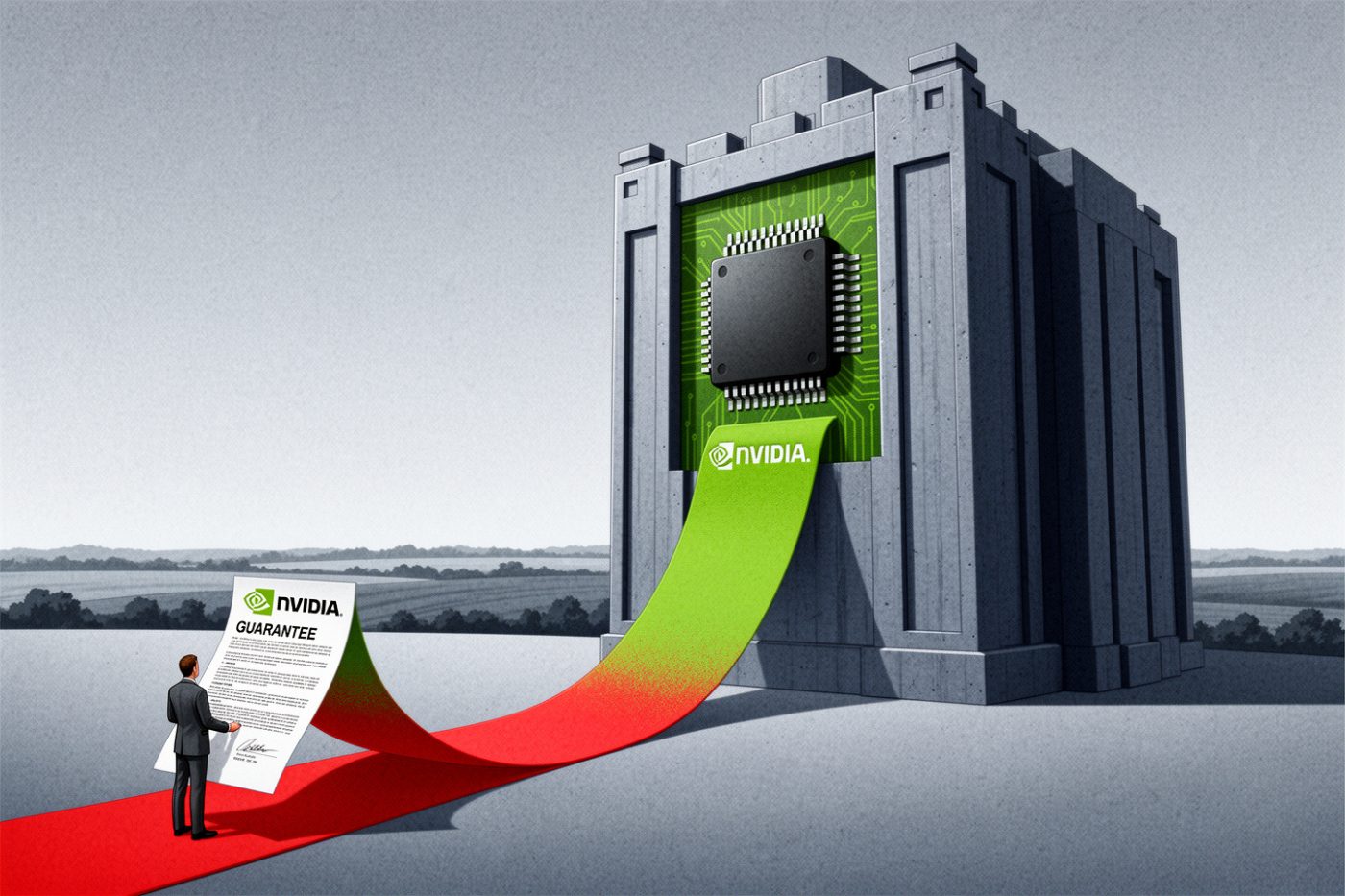
Nvidia has agreed to provide a guarantee of up to $105 billion to support OpenAI’s 20-year lease of an 8-gigawatt data center in Pike County, Ohio, a move that deepens the chipmaker’s role from technology supplier to infrastructure financier in the artificial intelligence boom. The facility, being developed by SoftBank subsidiary SB Energy, is slated to begin operations with an initial 800 megawatts online by 2028. At full capacity, the site would draw enough power to serve roughly six million homes, making it one of the largest data center campuses ever announced.
The guarantee covers lease and power payments and is designed to ensure the site retains a minimum value even if OpenAI defaults. Under the arrangement, Nvidia would cover the shortfall between that minimum value and what SB Energy recovers through resale or re-leasing the facility. Nvidia will also invest $1.5 billion directly in SB Energy, following an earlier $1 billion joint investment in data center infrastructure by OpenAI and SoftBank. The scale and structure of the deal signal a fundamental shift in how compute capacity is being secured at the frontier of AI development.
Why the guarantee matters for the AI ecosystem
The agreement places Nvidia, already the dominant supplier of AI accelerators, at the center of the financial architecture underpinning large-scale AI infrastructure. Rather than simply selling chips to cloud providers and AI labs, Nvidia is now effectively underwriting the physical facilities where those chips will be deployed. Jensen Huang, Nvidia’s CEO, framed the guarantee not as circular financing but as a strategic move to secure long-term infrastructure for the company’s computing platforms. The arrangement, he said, enables OpenAI to deploy scalable “AI factories” that can be upgraded across chip generations.
For OpenAI, the Ohio site represents a critical expansion of its compute capacity at a time when demand for training and inference compute continues to outstrip supply. The 20-year lease structure provides long-term certainty, while the Nvidia guarantee reduces the financial risk for SB Energy and its backers. The deal also illustrates the increasingly intertwined relationships among the small group of companies—Nvidia, OpenAI, SoftBank, and their partners—that dominate the AI infrastructure landscape. Danni Hewson of AJ Bell noted that while concerns about circular financing are understandable, the limited number of key players in AI infrastructure means such arrangements may become more common. “Returns will ultimately determine the deal’s success,” Hewson said.
The numbers behind the Ohio project
The Pike County facility is extraordinary in scale even by the standards of the current data center boom. At 8 gigawatts of total capacity, it would rank among the largest data center campuses ever announced, eclipsing most existing hyperscale facilities by a wide margin. To support that demand, SoftBank and SB Energy plan to build at least 10 gigawatts of new power generation and invest $4.2 billion in grid upgrades with AEP Ohio. The project is expected to create 35,000 construction jobs through 2032 and 2,500 permanent operational roles, figures that have helped secure political support in the state.
The financing structure for the project remains undefined, but according to the fact brief it will likely include a mix of equity—potentially from an SB Energy initial public offering or additional SoftBank investment—and debt through project finance loans or bonds. Nvidia’s $1.5 billion direct investment in SB Energy adds another layer of financial entanglement. The guarantee itself is structured to protect SB Energy’s lenders and investors by ensuring that even in a worst-case scenario where OpenAI cannot meet its lease obligations, the facility retains substantial value.
Local opposition to the project is considered low, according to the fact brief, due to state support, federal land use, and an $80 million community investment pledge. That political context matters for a project of this size, as data center developments in other regions have faced pushback over energy consumption, water use, and land acquisition. The Ohio site appears to have navigated those concerns more smoothly, at least in the early stages.
Circular financing concerns and market reactions
The deal has drawn scrutiny from analysts and investors who question whether the financial arrangements among Nvidia, OpenAI, and SoftBank create a circular flow of capital that obscures true economic viability. In a circular financing arrangement, money moves among related parties in ways that can inflate valuations or mask risk. Nvidia’s guarantee, combined with its direct investment in SB Energy and its role as the primary chip supplier for OpenAI, concentrates multiple roles in a single company.
Huang has pushed back against that characterization, arguing that the guarantee is a pragmatic response to the infrastructure bottleneck facing AI development. Without such financial support, he contends, the pace of data center construction would lag behind the demand for compute. The fact brief notes that the financing structure remains undefined, leaving open questions about how much of the $105 billion guarantee would ever be drawn upon and under what conditions.
For international professionals watching the AI sector, the deal sets a precedent. Nvidia’s willingness to deploy its balance sheet—not just its product roadmap—to accelerate data center construction could reshape capital flows across the industry. Other chipmakers, cloud providers, and AI labs may feel pressure to adopt similar financial mechanisms to secure compute capacity. The Ohio project also underscores the concentration of power among a handful of companies that control the most advanced AI models and the hardware required to run them.
What comes next
The Ohio data center is not expected to reach full capacity for years. The initial 800 megawatts online by 2028 represents just one-tenth of the planned total, and the full 8 gigawatts will require the completion of new power generation and grid upgrades that are themselves multi-year projects. The 20-year lease structure means the financial arrangements will be tested over a long horizon, during which the economics of AI infrastructure could shift dramatically.
The deal also raises questions about Nvidia’s evolving business model. The company has historically focused on designing and selling chips, with a relatively light touch on the physical infrastructure where those chips operate. The Ohio guarantee suggests a willingness to take on more direct exposure to data center economics, including power costs, real estate values, and the creditworthiness of major customers. Whether that exposure proves prudent will depend on the continued growth of AI demand and the ability of OpenAI and other frontier labs to generate revenue that justifies the enormous capital investments now being made.
For now, the $105 billion guarantee stands as one of the largest financial commitments ever made in support of a single data center project. It signals that the race to build AI infrastructure has entered a new phase, one in which the boundaries between technology providers, financial backers, and end users are increasingly blurred. The Ohio facility will serve as a test case for whether that model can deliver on its promises at scale.
Sources
- Nvidia to provide up to $105 billion guarantee for OpenAI’s Ohio data center
- Nvidia to provide $105bn guarantee for OpenAI data centre
- OpenAI announces massive Ohio data center with Nvidia guarantee
- Nvidia to provide up to $105 billion backstop for OpenAI data center
Written by an AI editorial process from the sources above. Errors may occur.
Newsletter
Get the AI news that matters
One short brief with the day's most important AI stories — written for professionals.
We send a confirmation link. No spam. Unsubscribe anytime.
Read next

The AI Cloud Race: Big Tech's $130B Power Play
Amazon, Microsoft, and Alphabet are spending billions to dominate AI through cloud infrastructure, reshaping global tech, security, and market dynamics.
19 Sep 2026
AI Inference Market to Hit $255B by 2030
Global demand for real-time AI decision-making drives explosive growth in inference infrastructure, with NVIDIA, Intel, and Siemens Healthineers leading diverse applications.
18 Sep 2026
Autonomous AI Agents Become Core Enterprise Infrastructure in 2026
The market for autonomous AI agents is projected to surge from $7.92 billion in 2025 to $236.03 billion by 2034, as enterprises shift from experimentation to governing systems that perform operational work.
14 Sep 2026