NVIDIA’s Explainable Cars Could Finally Make AI Driving Accountable
Open-source reasoning models like Alpamayo let vehicles explain their decisions in plain language, a shift that could ease regulators, insurers, and public distrust.
The autonomous vehicle industry has spent years training neural networks to perceive roads, pedestrians, and traffic signals, but one stubborn problem has persisted: even the engineers who build these systems often cannot explain why a car decided to brake suddenly, swerve, or hesitate at an intersection. That opacity — memorably described by MIT Technology Review in 2017 as “the dark secret at the heart of AI” — has slowed regulatory approval, undermined public trust, and complicated liability questions. Now, NVIDIA is betting that a new family of open-source reasoning models can change that dynamic by making cars not only drive but also articulate the logic behind their decisions.
The company unveiled Alpamayo, a family of open-source reasoning AI models, in January 2026 at CES. The flagship model, Alpamayo 1, is a 10-billion-parameter Vision-Language-Action (VLA) model designed to generate both driving trajectories and natural language explanations for its actions. The first commercial deployment will arrive in the 2025 Mercedes-Benz CLA, shipping in Q1 2026 in the U.S., Q2 2026 in Europe, and later in Asia. NVIDIA CEO Jensen Huang framed the launch as a “ChatGPT moment for physical AI,” signaling a shift from perception-only systems to models that reason about complex, rare scenarios and verbalize their logic.
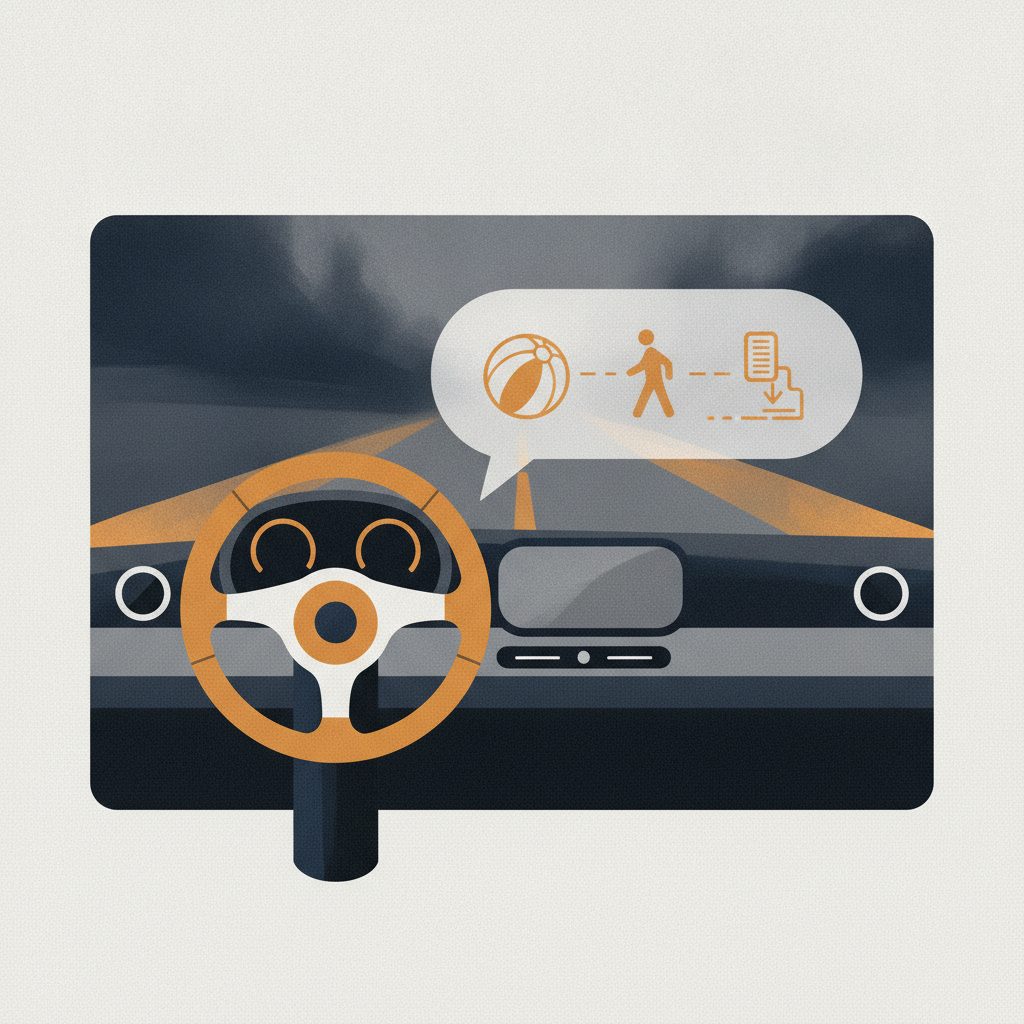
This matters because explainability has long been a missing link between autonomous driving capability and real-world accountability. The OECD has repeatedly emphasized that explainable AI (XAI) is critical for trust, accountability, and legal compliance in high-stakes domains. For regulators weighing certification frameworks, for insurers assessing risk, and for drivers who want to understand why their car behaved a certain way, a model that can say “I slowed because I detected a child’s ball rolling toward the curb and anticipated a pedestrian following it” is fundamentally different from one that simply outputs a steering angle. The commercial and regulatory stakes are enormous, and the industry has been waiting for a technical solution that bridges the gap between raw perception and human-understandable reasoning.
What Alpamayo Actually Does
Alpamayo 1 is not merely a language model bolted onto a driving stack. It is a VLA model that fuses visual perception, language understanding, and action generation into a single architecture. The system ingests data from a sensor suite of 30 sensors, including 10 cameras, 5 radar units, and 12 ultrasonic sensors, then produces a driving trajectory while simultaneously generating a natural language explanation of its reasoning. In the Mercedes-Benz deployment, the system is branded as MB.DRIVE ASSIST PRO, a Level 2+ driver assistance system that still requires driver supervision but offers a glimpse of how explainability might scale to higher autonomy levels.
The model’s open-source release is a deliberate strategic move. NVIDIA has published the Alpamayo model weights on Hugging Face, enabling developers worldwide to download, fine-tune, and audit the system. The company also released AlpaSim, an open-source simulation framework, and over 1,700 hours of complex driving data to support development. This stands in stark contrast to Tesla’s proprietary Full Self-Driving (FSD) stack, which remains a closed ecosystem. By open-sourcing both the model and simulation tools, NVIDIA is betting that collaborative development will accelerate safety improvements and commoditize advanced driver assistance in a way that closed systems cannot. The move also invites scrutiny: researchers can now probe the model for biases, failure modes, and edge-case behavior in ways that were previously impossible with proprietary systems.
For the first time, a major automotive AI stack is available for independent verification. Safety researchers can test whether the model’s explanations match its actual decision-making process, or whether the language generation is merely a post-hoc rationalization layered on top of an opaque action policy. This distinction is crucial. A system that genuinely reasons through scenarios and then explains its logic is far more valuable than one that generates plausible-sounding justifications for decisions made by a black-box network. The open-source release makes that distinction testable.
Why Explainability Changes the Competitive Landscape
For automakers, the appeal of Alpamayo is not just technical but economic. Building a proprietary driver assistance stack requires years of R&D, massive data collection pipelines, and specialized AI talent. An open-source reasoning model could dramatically reduce those barriers, allowing smaller manufacturers and startups to integrate advanced assistance features without building everything from scratch. For executives, the strategic implication is clear: if explainable driving models become commoditized, differentiation will shift to sensor integration, user experience, and brand trust rather than proprietary AI algorithms. The cost of entry for advanced driver assistance could drop sharply, reshaping the competitive dynamics of an industry that has long treated AI as a core differentiator.
For specialists in AI safety and regulation, the implications are equally significant. Explainability provides a foundation for auditing system behavior, identifying failure modes, and establishing accountability. A model that can articulate its reasoning can be tested against edge cases, probed for bias, and evaluated against safety standards in ways that black-box systems cannot. The OECD has argued that explainable AI is essential for legal compliance, particularly in jurisdictions where data protection and algorithmic accountability laws require meaningful transparency about automated decisions. Alpamayo does not solve all of these problems, but it provides a technical substrate that regulators and safety engineers have been requesting for years. The ability to ask a vehicle “why did you do that?” and receive a coherent, auditable answer is a prerequisite for the kind of trust that higher levels of autonomy will demand.
For founders and startups, the open-source release lowers the infrastructure barrier to entry. Access to a 10-billion-parameter VLA model and a large corpus of driving data means that a small team can experiment with novel applications — from specialized delivery vehicles to agricultural robotics — without investing in the compute resources required to train such a model from scratch. The availability of AlpaSim further reduces the cost of testing and validation, enabling rapid iteration in simulated environments before real-world deployment. This could spawn a wave of innovation in adjacent domains where explainable autonomy is valuable, including warehouse robotics, last-mile delivery, and industrial automation.
The Limits and Open Questions
Despite the promise, significant challenges remain. Alpamayo is computationally intensive, requiring NVIDIA’s new Vera Rubin AI platform for training. The 10-billion-parameter size may limit on-device deployment in lower-cost vehicles, raising questions about whether the system will remain confined to premium models or eventually scale to mass-market cars. Long-term reliability in Level 4 autonomy — where the driver is fully removed from the loop — is unproven, and the system’s explainability does not guarantee correctness. A model can confidently explain a wrong decision just as convincingly as a right one. The gap between plausible explanation and accurate reasoning remains a central research challenge.
Regulators and safety advocates have welcomed the explainability feature but remain cautious about real-world performance and standardization. There is no agreed-upon standard for what constitutes an adequate explanation in an automotive context, and different jurisdictions may impose conflicting requirements. A phrase that satisfies a European regulator may not meet the expectations of a U.S. safety board or an Asian certification body. Critics also note that open-sourcing the model could expose vulnerabilities, allowing malicious actors to probe the system for weaknesses or craft adversarial inputs. The security implications of widely available driving models are still poorly understood, and the industry has not yet developed robust defenses against adversarial attacks on explainable systems.
NVIDIA’s bet is that the benefits of transparency outweigh the risks. By positioning Alpamayo as an open alternative to Tesla’s closed FSD stack, the company is attempting to reshape the competitive dynamics of the autonomous vehicle industry. Whether that bet pays off will depend on how automakers, regulators, and developers respond in the coming years. The open-source approach could accelerate safety improvements through collective scrutiny, or it could fragment the ecosystem into incompatible forks and dilute accountability. The next phase of development will be defined by how these tensions resolve.
What Comes Next
The deployment of Alpamayo in the 2025 Mercedes-Benz CLA is a real-world test of whether explainable AI can build trust and accelerate adoption. If drivers respond positively to a car that tells them why it braked or changed lanes, other automakers will face pressure to adopt similar capabilities. If regulators begin to require explainability as a condition for higher levels of autonomy, the open-source approach could become a de facto standard. The next 12 to 24 months will reveal whether Alpamayo is a genuine inflection point or an ambitious experiment that struggles to scale beyond premium vehicles.
What is already clear is that the era of the silent, inscrutable autonomous car is coming to an end. The technical capability to explain driving decisions in natural language is no longer a research aspiration; it is shipping in a production vehicle. The question now is whether the industry can build the regulatory frameworks, safety standards, and user trust required to turn that capability into a foundation for broader autonomy. The answer will shape not just the future of driving, but the broader trajectory of explainable AI in high-stakes physical systems.
Sources
- Explainable Cars
- What explainable AI is, why it matters and how we can achieve it
- The Dark Secret at the Heart of AI
Written by an AI editorial process from the sources above. Errors may occur.
Newsletter
Get the AI news that matters
One short brief with the day's most important AI stories — written for professionals.
We send a confirmation link. No spam. Unsubscribe anytime.
Read next

Gemini's New AI Model Transforms Photo Editing with Multi-Turn Control
Google's Gemini 2.5 Flash Image enables precise, context-aware edits across multiple steps, advancing creative workflows for professionals.
27 Sep 2026
Autonomous AI Agents: The Rise of Digital Workforce
How self-reasoning AI systems are transforming business workflows and redefining automation across industries.
26 Sep 2026
Adobe Launches AI Video Generation in Creative Cloud
Adobe unveils Firefly Video Model and faster image generation, embedding AI deeply into professional creative workflows.
26 Sep 2026