Autonomous Vehicles 2026: Scaling, Safety, and the Road to Mass-Market Autonomy
The self-driving car industry is moving beyond geofenced robotaxis toward consumer autonomy, with revenue projected to hit $626.9 billion this year—but safety and liability questions remain after a recent Waymo incident.
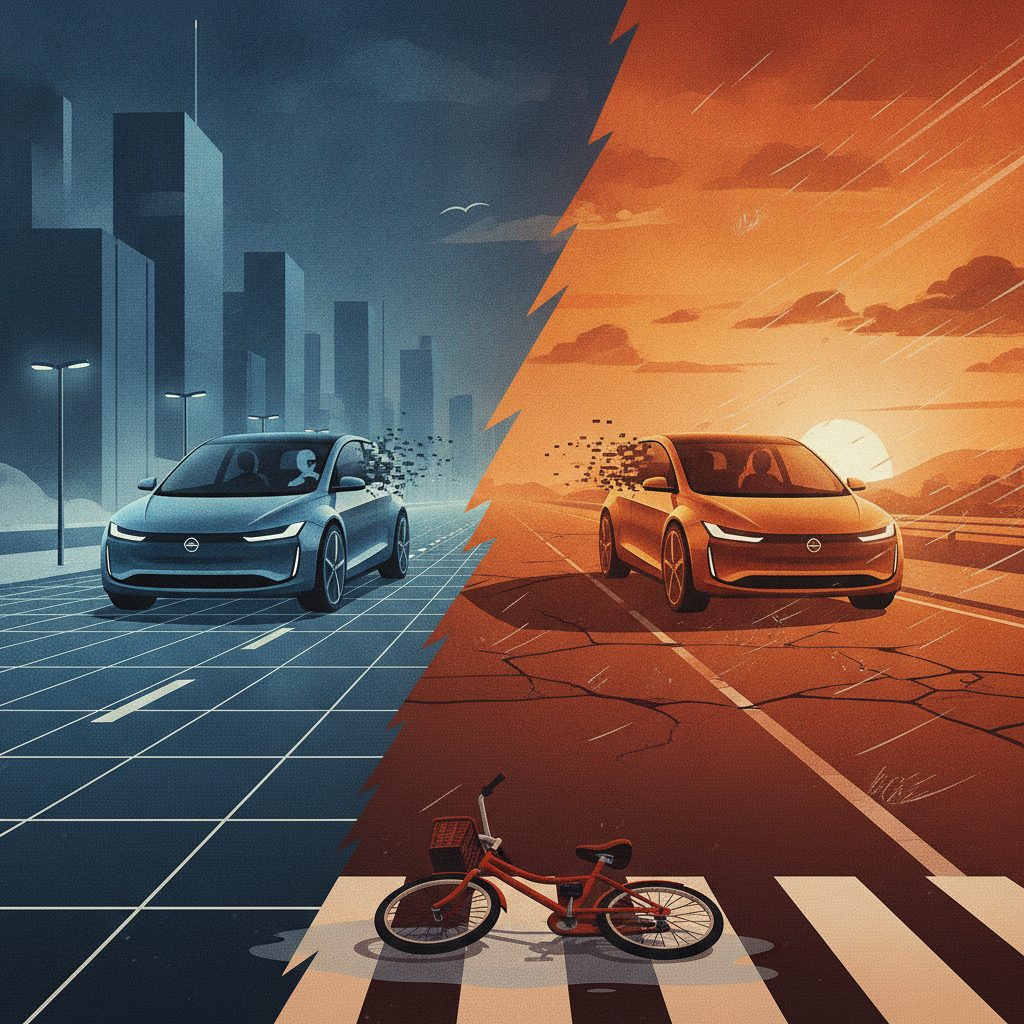
On March 3, 2026, the autonomous vehicle industry has crossed a threshold: it is no longer asking whether self-driving cars will arrive, but how quickly they will scale. Zoox has begun carrying passengers in Las Vegas, Ford is promising mass-market Level 3 autonomy by 2028, and market researchers project global autonomous vehicle revenue of USD 626.9 billion this year. Yet the same week, reports of a Waymo vehicle striking a child near a school served as a reminder that the technology’s safety case is still being written.
The stakes extend well beyond any single company. Autonomous driving sits at the intersection of artificial intelligence, transportation infrastructure, urban planning, logistics, and regulation. For executives and policymakers, the 2026 landscape matters because decisions made now—on safety standards, liability, connectivity, and manufacturing cost—will determine whether autonomy becomes a broadly available feature or remains a premium, geofenced service. The industry’s revenue trajectory and the shift toward edge AI suggest the former is increasingly likely, but not yet guaranteed.
From robotaxi deployments to affordable autonomy
In late 2025, Amazon-owned Zoox launched its purpose-built robotaxi service in Las Vegas, with San Francisco planned as its next market. Unlike retrofitted passenger cars, Zoox vehicles are designed without a steering wheel and operate at Level 4 autonomy, meaning they can drive themselves within a defined operational design domain. Most consumer vehicles, by contrast, remain at Level 2 or Level 3, where a human driver must still be ready to take over. The Society of Automotive Engineers’ scale runs from Level 0 (no automation) to Level 5 (full autonomy in all conditions), and in 2026 the consumer market sits firmly in the middle.
Ford’s BlueCruise is a current Level 2 system; in 2026 it is receiving upgrades, and Ford is preparing a new AI assistant for in-vehicle experiences by 2027. The company’s UEV platform is aimed at democratizing autonomy, with a target of USD 30,000 vehicles and Level 3 capability by 2028. That recalibration from full EVs to autonomy positions Ford for mass-market Level 3, making hands-free, eyes-off driving more accessible to everyday drivers rather than only premium buyers. Audi, meanwhile, is enhancing Level 2 augmented reality displays to improve driver awareness and safety.
A market measured in hundreds of billions
The commercial scale is becoming concrete. According to market data cited in the Calmops report, global autonomous vehicle revenue is projected to reach USD 626.9 billion in 2026, rising to USD 850.6 billion in 2027 and USD 1,065.3 billion in 2028. By 2029, the market is expected to hit USD 1,502.1 billion, with semi-autonomous vehicles contributing USD 830.66 billion and fully autonomous vehicles USD 671.44 billion. The trajectory continues to USD 2,038.3 billion in 2030. These figures cover both consumer and commercial segments, from advanced driver assistance systems to robotaxis and autonomous trucks.
The split between semi-autonomous and fully autonomous revenue matters because it shows that the near-term economic opportunity is not only in driverless robotaxis. Level 2 and Level 3 systems, sold across millions of passenger vehicles, are expected to generate more revenue than fully autonomous vehicles through 2029. That helps explain why Ford, Audi, and other mass-market automakers are investing in incremental autonomy while companies like Zoox and Waymo pursue Level 4 robotaxi fleets.
Edge AI becomes the real-world test
One of the most important technical shifts in 2026 is the move from geofenced robotaxi operations to consumer autonomous vehicles that must handle any road, weather, and network condition. The BYD/Wayve consumer AV trend highlights this challenge: unlike a robotaxi with a known operational design domain, a consumer vehicle cannot rely on a single carrier network or a fixed map. It requires persistent eSIM-based multi-carrier connectivity with sub-100ms failover, continuous over-the-air model updates pushed to millions of vehicles at once, and edge inference governance that keeps safety-critical decisions local even when connectivity drops. This is a harder engineering problem than running a small fleet in a mapped city, and it is where AI meets the physical world most directly.
The same logic extends beyond passenger cars. Aurora has stated that its autonomous trucks can make the roughly 15-hour trip from Phoenix to Fort Worth without a human driver, a milestone for long-haul logistics. In China, Neolix has begun deploying self-driving delivery vans on public roads, sometimes with uneven results. These examples show that autonomy is not one product but a family of systems, each with different operational constraints and economic models.
Safety, liability, and the trust gap
Even as deployments expand, safety remains the central unresolved issue. A recent crash in which a Waymo vehicle hit a child near a school has renewed scrutiny of how autonomous systems behave in complex, low-speed, high-stakes environments. The US National Highway Traffic Safety Administration estimates that 94% of car crashes involve human error, which is often cited as the core argument for autonomy. But that statistic does not eliminate the need to prove that machine drivers can handle the remaining edge cases reliably. Liability questions—who is responsible when a Level 3 system hands control back to a distracted human, or when a Level 4 robotaxi makes a mistake—are still being worked out across jurisdictions.
By the end of the year, self-driving cars will be boring. People’s fears will be largely assuaged, the recipe for scaling will be clear, and the technology will be broadly acknowledged as solved.
That prediction, from robotics researcher Chris Paxton, captures the optimism among some industry observers. Others are more cautious, pointing to the gap between controlled deployments and the messy reality of public roads. On Reddit’s self-driving car forum, one widely discussed 2026 prediction is that Waymo will further increase its lead and finish validating winter weather, a step that would expand its operational domain beyond the sunny cities where most robotaxis have been tested so far. Paxton also notes that honest, high-quality competition for Waymo from Nuro, Zoox, and Tesla seems farther off, as all three companies remain significantly behind in the United States.
The road ahead in 2026 is defined by a dual movement: robotaxi services are becoming a commercial reality in select cities, while automakers like Ford are preparing to bring hands-free, eyes-off driving to mass-market vehicles within a few years. The revenue projections, the edge AI investments, and the expansion into trucking and delivery all point in one direction—autonomy is becoming infrastructure. But the child-involved Waymo crash and unresolved liability rules show that public trust is not automatic. The companies that scale safely, communicate honestly about limitations, and work with regulators rather than against them are the ones most likely to turn 2026 from a year of milestones into the beginning of a boring, reliable, and broadly adopted autonomous future.
Sources
- Autonomous Vehicles 2026: The State of Self-Driving Cars, AI, and the Road Ahead - Calmops
- Autonomous Vehicles and Self-Driving Cars in 2026
- Autonomous Vehicles Statistics and Facts (2026)
- The State of the Self-Driving Car in 2026 - by Chris Paxton
- My 2026 AV predictions : r/SelfDrivingCars - Reddit
Written by an AI editorial process from the sources above. Errors may occur.
Newsletter
Get the AI news that matters
One short brief with the day's most important AI stories — written for professionals.
We send a confirmation link. No spam. Unsubscribe anytime.
Read next

The AI Cloud Race: Big Tech's $130B Power Play
Amazon, Microsoft, and Alphabet are spending billions to dominate AI through cloud infrastructure, reshaping global tech, security, and market dynamics.
19 Sep 2026
AI Inference Market to Hit $255B by 2030
Global demand for real-time AI decision-making drives explosive growth in inference infrastructure, with NVIDIA, Intel, and Siemens Healthineers leading diverse applications.
18 Sep 2026
Autonomous AI Agents Become Core Enterprise Infrastructure in 2026
The market for autonomous AI agents is projected to surge from $7.92 billion in 2025 to $236.03 billion by 2034, as enterprises shift from experimentation to governing systems that perform operational work.
14 Sep 2026