Automated driving stages an AI-powered comeback
After years of EV-first strategies, automakers and tech firms are pouring billions into autonomy as end-to-end AI lowers costs and robotaxi operations scale globally.
Automated driving is back at the center of the automotive industry’s strategic agenda. At CES 2026 in Las Vegas, the technology that once promised to reshape mobility—and then faded amid technical setbacks and cost overruns—re-emerged as a dominant force, powered by rapid advances in artificial intelligence. BMW, Ford, General Motors and Nvidia were among the companies announcing significant new commitments to automated driving development, signaling a shift in focus away from electric vehicles and back toward autonomy. The announcements were not isolated experiments; they represented a broader recalibration of capital and engineering resources after years in which electrification dominated strategic planning.
The renewed momentum matters because it is not merely a product cycle. The global autonomous vehicle market is now valued at approximately USD 2.6 trillion and is growing at a compound annual growth rate of 13.9%, with projections reaching USD 8.4 trillion by 2035. For executives and founders, this marks a critical investment and strategic inflection point: the convergence of AI-native software and stabilized hardware has created a massive market where safety, unit economics and consumer trust are becoming the new competitive currencies, fundamentally reshaping the future of mobility and urban logistics.
A strategic reset from electric vehicles to autonomy
For much of the early 2020s, automakers poured capital into electrification, while automated driving programs were scaled back or quietly deprioritized. Technical challenges—particularly around edge cases, sensor reliability and the cost of high-definition mapping—had cooled the enthusiasm that once surrounded robotaxis and hands-free highway systems. But the AI boom has changed the calculus. Large-scale neural networks, improved simulation and cheaper compute have made it possible to train driving systems on vast amounts of real-world and synthetic data, reducing the reliance on hand-coded rules and expensive sensor stacks. This shift is not simply a return to old ambitions; it reflects a maturing technology base that can support commercial deployment at a scale that was not feasible five years ago.
The geographic shape of the comeback is uneven. North America holds the largest market share at 37.1%, driven by early commercial deployments and a dense ecosystem of technology suppliers. The Asia-Pacific region is the fastest-growing, with China leading in Level 4 deployments across more than 20 cities. That regional divergence reflects different regulatory approaches, infrastructure readiness and consumer acceptance, but it also underscores that automated driving is no longer a single-country story. The competitive map is being redrawn as Chinese operators scale urban robotaxi services and U.S. companies expand internationally.
The scale of the commercial push
The numbers behind the resurgence are concrete. Waymo, the Alphabet-owned company that has long been the benchmark for robotaxi operations, now provides more than 500,000 robotaxi rides weekly in the United States and plans to expand to London and Tokyo in 2026. That weekly ride volume is not a theoretical target; it represents ongoing commercial operations that generate real revenue, operational data and passenger feedback. Uber, which once sold its self-driving unit, is now aiming to offer driverless rides in 15 cities by the end of the year and is launching its Gravity robotaxi with Lucid. Amazon-backed Zoox is expanding testing to Houston and San Diego, adding new urban environments to its existing operations and broadening the conditions under which its purpose-built vehicle is evaluated.
The autonomous driving software segment alone is valued at USD 23.1 billion, a figure that reflects the growing willingness of automakers and fleet operators to pay for AI-driven perception, planning and control systems rather than build everything in-house. This commercial activity is not limited to robotaxis. Logistics providers, delivery networks and municipal transit agencies are also evaluating automated systems as a way to address driver shortages and improve unit economics. The breadth of interest suggests that automated driving is becoming a horizontal technology layer across passenger mobility and freight, not a niche experiment.
End-to-end AI reshapes the technology stack
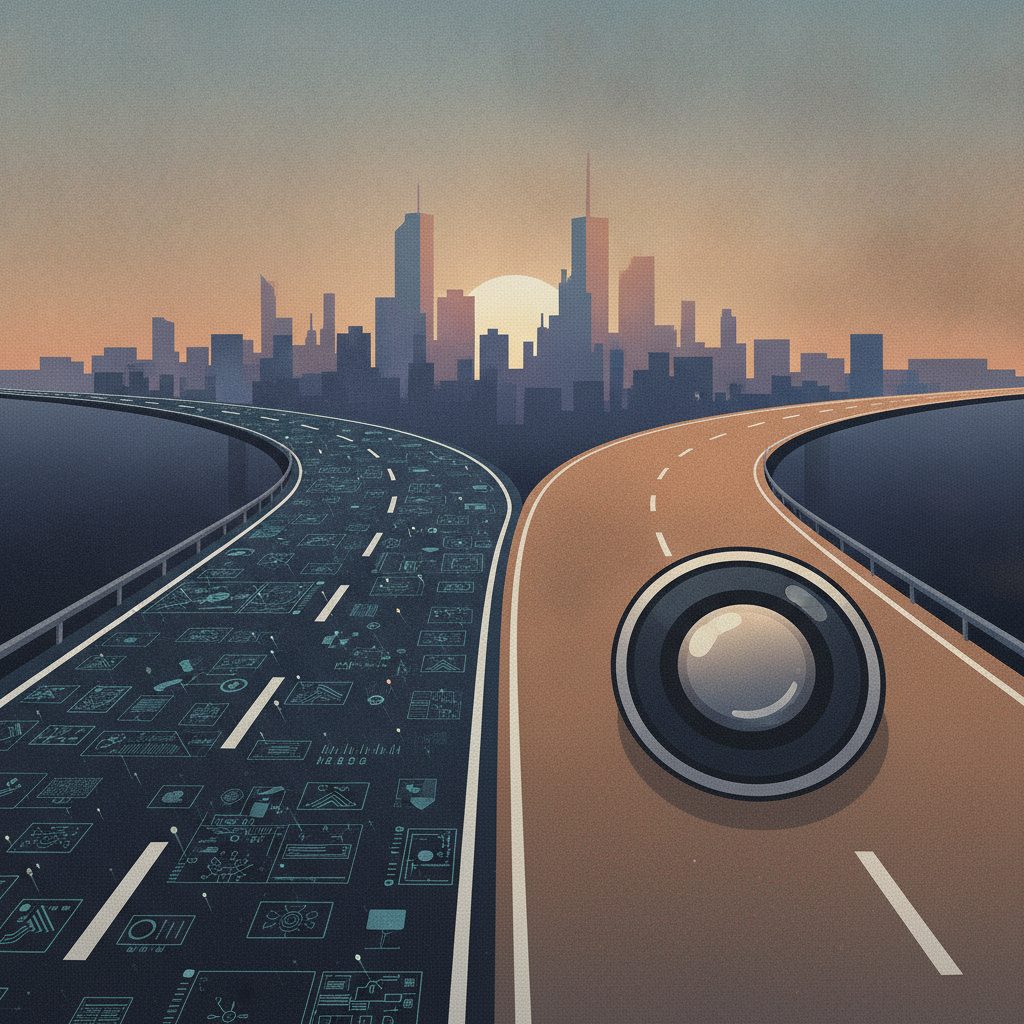
A major technological shift is the move toward end-to-end AI systems. Instead of separate modules for perception, prediction and planning, these systems train a single neural network to map sensor inputs directly to driving actions. Wayve, a UK-based company, is pioneering a camera-only, mapless approach using embodied AI. In 2026, Wayve raised USD 1.2 billion to fund its commercial deployment, betting that a leaner sensor suite and no pre-built HD maps can scale faster and cheaper across cities and countries. The company’s approach removes the need for continuous map updates, but it must demonstrate that a camera-only system can match the safety margins of more redundant architectures in low visibility, severe weather and unexpected road conditions.
This contrasts sharply with Waymo’s sensor-rich, map-dependent system, which relies on lidar, radar and detailed prior maps to navigate. The industry remains split on the optimal technical path. Camera-only advocates argue that eliminating lidar and HD maps reduces cost and complexity, while sensor-fusion proponents point to the safety margins that redundant sensing provides in low visibility or unexpected road conditions. TomTom has leveraged AI to dramatically scale its HD mapping, now capable of mapping 470,000 miles, or 750,000 kilometers, per day for clients like Volkswagen—evidence that the map-dependent approach is also becoming more efficient, not obsolete. The unresolved debate means that near-term deployments will likely include a mix of architectures, with different players optimizing for different operating domains and cost structures.
The trust gap remains the critical bottleneck
Despite the commercial acceleration, a significant trust gap persists. According to industry research, 70% of consumers are concerned about cybersecurity in automated vehicles, and 68% are skeptical of how vehicles handle edge cases such as severe weather, sudden road closures or unpredictable human behavior.
- 70% of consumers concerned about cybersecurity
- 68% skeptical of how vehicles handle edge cases like severe weather
These concerns are not abstract; they directly affect adoption rates, regulatory approval and insurance costs. A single high-profile failure can set back public confidence for years, as the industry learned during earlier testing incidents. The trust gap also has a commercial dimension: passengers and fleet customers will not pay a premium for automated services if they doubt the system’s ability to protect data or handle rare but dangerous situations.
The unresolved technical debate between camera-only and sensor-fusion approaches adds another layer of uncertainty. No clear winner has emerged, and different companies are placing large bets on divergent architectures. For executives, this means the competitive landscape will be shaped not only by engineering talent but also by the ability to communicate safety convincingly to regulators and the public. Unit economics will matter as much as technical capability: a robotaxi service that cannot operate profitably at scale will struggle to attract sustained investment, regardless of its safety record.
The comeback of automated driving is real, but it is not a return to the hype of the late 2010s. This time, the foundations are more substantial: AI-native software, stabilized hardware, and early commercial deployments that generate real revenue and operational data. The next phase will be defined by which companies can close the trust gap, resolve the technical architecture debate, and demonstrate that automated driving can be safe, affordable and scalable across different markets. For global executives and founders, the signal is clear: autonomy is once again a strategic priority, and the window to shape its economics and standards is open now.
Sources
- Automated driving is staging a comeback with the help of AI
- Automated driving is staging a comeback with the help of AI
- AI-First Software and Simulation for ADAS to Autonomous Driving | Helm.ai
- What is AI in Self-Driving Cars: How They Work in 2026
- Leveling up AI: how close are we to self-driving cars?
Written by an AI editorial process from the sources above. Errors may occur.
Newsletter
Get the AI news that matters
One short brief with the day's most important AI stories — written for professionals.
We send a confirmation link. No spam. Unsubscribe anytime.
Read next

The AI Cloud Race: Big Tech's $130B Power Play
Amazon, Microsoft, and Alphabet are spending billions to dominate AI through cloud infrastructure, reshaping global tech, security, and market dynamics.
19 Sep 2026
AI Inference Market to Hit $255B by 2030
Global demand for real-time AI decision-making drives explosive growth in inference infrastructure, with NVIDIA, Intel, and Siemens Healthineers leading diverse applications.
18 Sep 2026
Autonomous AI Agents Become Core Enterprise Infrastructure in 2026
The market for autonomous AI agents is projected to surge from $7.92 billion in 2025 to $236.03 billion by 2034, as enterprises shift from experimentation to governing systems that perform operational work.
14 Sep 2026