AI Powers Next-Gen Autonomous Vehicles Through Simulation and Edge Computing
From synthetic data to real-time decision-making, AI is transforming how self-driving cars learn, adapt, and interact with smart mobility ecosystems.
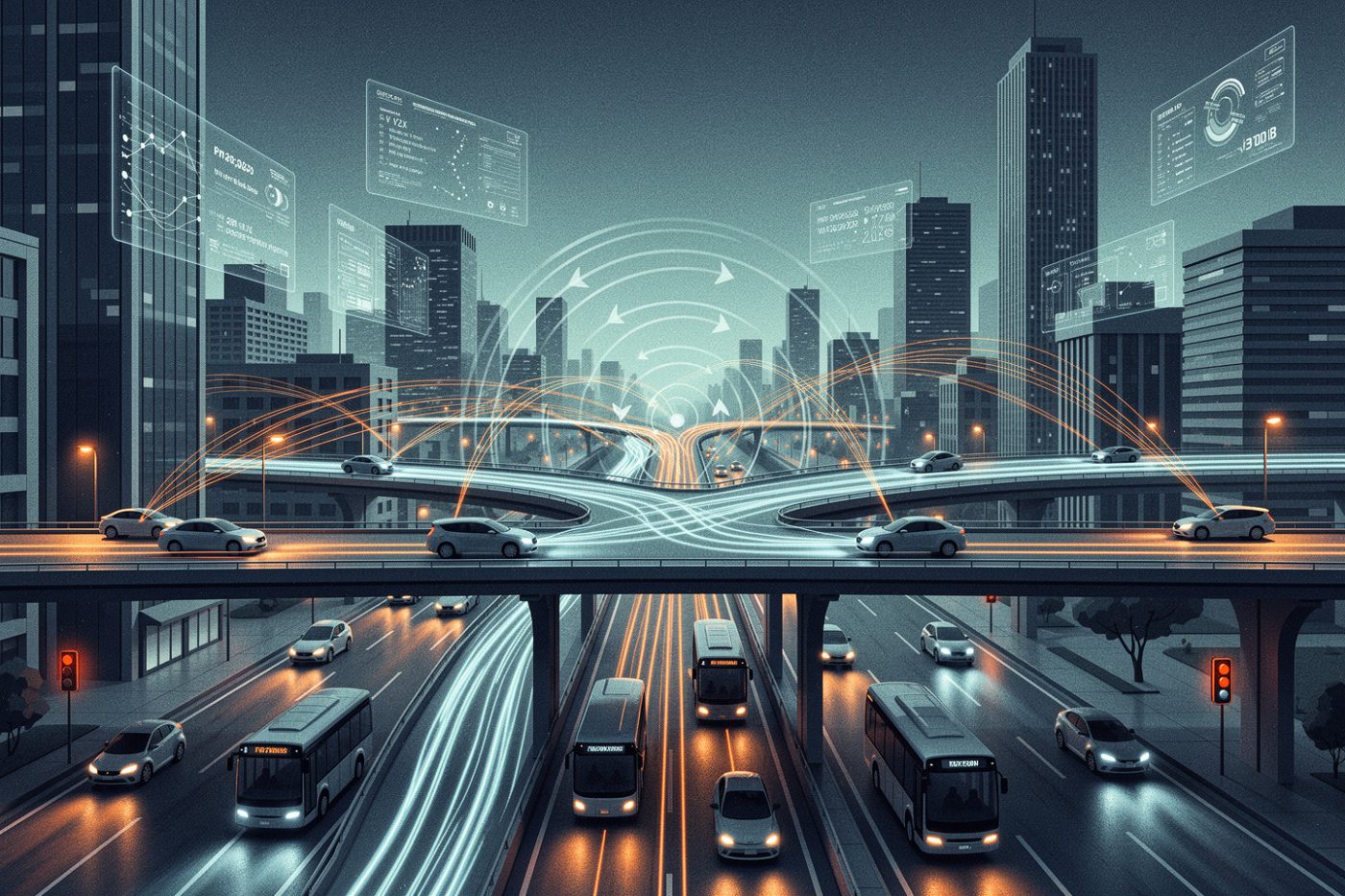
Generative Adversarial Networks (GANs) are generating hyper-realistic urban environments—complete with pedestrians, dynamic lighting, moving vehicles, and complex traffic patterns—enabling autonomous vehicle systems to train and validate in synthetic yet lifelike conditions. This shift toward AI-generated simulation is accelerating the development of self-driving technology while reducing costs, minimizing real-world risks, and overcoming data scarcity. As AI becomes the central nervous system of next-generation mobility, it’s not just transforming how cars drive, but how they learn, adapt, and interact with entire transportation ecosystems.
The stakes are high. Autonomous vehicles must process terabytes to petabytes of sensory data daily—far beyond what traditional CPUs can handle. To meet this demand, automakers and tech firms are deploying GPUs and specialized Systems-on-Chip (SoCs), such as NVIDIA’s Orin and Thor, which deliver high computational throughput with optimized power efficiency. These hardware advances, combined with sophisticated AI models, enable real-time decision-making, multi-sensor fusion, and Vehicle-to-Everything (V2X) communication. But even with cutting-edge infrastructure, maintaining reliable autonomy requires continuous model updates, resilient connectivity, and a rethinking of how AI evolves in dynamic environments.
Synthetic Data and the Training Revolution
One of the most transformative applications of AI in autonomous driving is the use of synthetic data generated by GANs. These networks pit two neural models—a generator and a discriminator—against each other to produce photorealistic scenes that mimic real-world complexity. By simulating rare or dangerous scenarios like jaywalking pedestrians, sudden weather changes, or erratic drivers, developers can test edge cases at scale without endangering lives.
The benefits extend beyond safety. Real-world data collection is expensive, time-consuming, and often limited in diversity. Synthetic environments allow engineers to generate millions of virtual miles overnight, covering conditions that might take years to encounter organically. According to DXC Technology, this approach drastically reduces training costs and accelerates validation cycles. For companies racing to deploy safe autonomy, synthetic data has become a force multiplier.
Yet challenges remain. While GANs can simulate visual realism, replicating the full physics of sensor behavior—such as LiDAR reflections under fog or camera glare from low sun angles—requires additional layers of modeling. Moreover, over-reliance on synthetic data risks creating models that perform well in simulation but fail in unpredictable real-world interactions. The solution lies in hybrid training: combining synthetic breadth with curated real-world data to ensure robustness.
Hardware and Infrastructure: Powering Real-Time Autonomy
Processing the torrent of data from cameras, radar, LiDAR, and V2X feeds demands more than just software intelligence—it requires purpose-built hardware. CPUs alone cannot sustain the parallel computations needed for perception, prediction, and path planning. Instead, AI-driven vehicles rely on GPU-accelerated platforms capable of executing trillions of operations per second.
NVIDIA’s Orin SoC, for example, delivers up to 254 TOPS (trillion operations per second), enabling automakers to run multiple deep neural networks simultaneously for object detection, lane tracking, and behavioral forecasting. Its successor, Thor, pushes performance to 1,000 TOPS, consolidating functions from digital cockpits to autonomous driving into a single chip. Such integration improves energy efficiency and reduces system complexity—critical factors for mass-market adoption.
But onboard compute is only half the equation. Edge computing and low-latency networks are equally vital. As highlighted in discussions around physical AI, autonomous systems depend on distributed processing close to the source of data. In smart cities, roadside units equipped with edge servers can preprocess traffic information, detect congestion patterns, and relay warnings to approaching vehicles faster than cloud-based systems allow. This synergy between vehicle-side AI and infrastructure-level intelligence forms the backbone of scalable autonomy.
Model Maintenance and the Challenge of Adaptation
Unlike static software, AI models in self-driving cars cannot be trained once and deployed indefinitely. Over time, environmental shifts—new road layouts, evolving traffic laws, seasonal variations—can cause “model drift,” where the relationship between input data and expected output degrades. A model trained primarily on California highways may struggle with narrow European alleys or monsoon conditions in Southeast Asia.
To counteract drift, autonomous systems require continuous learning pipelines. Over-the-air (OTA) updates enable fleets to receive revised models based on aggregated fleet data. Tesla, for instance, leverages anonymized driving logs from its global user base to refine Autopilot algorithms weekly. Similarly, Waymo and Cruise use closed-loop simulation to replay real incidents and improve response accuracy.
However, constant adaptation introduces new risks. Poorly validated updates could introduce regressions or unsafe behaviors. Ensuring reliability demands rigorous testing frameworks, version control, and fallback mechanisms. Some experts advocate for modular AI architectures, where core safety functions remain isolated from experimental features, allowing innovation without compromising stability.
Beyond the Car: AI in Smart Mobility Ecosystems
The impact of AI in mobility extends far beyond individual vehicles. In smart cities, autonomous systems are becoming nodes in a larger network of connected infrastructure. Through V2X communication, cars exchange speed, position, and hazard alerts with traffic signals, pedestrian crosswalk sensors, and other vehicles. This enables coordinated maneuvers like platooning on highways or green-wave optimization in urban corridors, reducing stop-and-go traffic and emissions.
Early deployments illustrate this potential. In Phoenix, Waymo operates a commercial robotaxi service navigating mixed traffic using real-time data fusion. In Shenzhen, drone deliveries and automated port operations leverage similar AI stacks for navigation and collision avoidance. Mining and logistics hubs have become proving grounds for yard automation, where AI coordinates fleets of driverless trucks with precision unattainable by human operators.
Investors are taking note. As Robeco Global observes, the technologies powering autonomous mobility—AI processors, machine vision, battery systems—are finding applications across industries. The same chips used in self-driving cars accelerate workloads in data centers; the same sensors enhance robotics in warehouses; the same energy management solutions support grid resilience. This convergence means advancements in automotive AI ripple outward, fueling innovation in manufacturing, logistics, and urban planning.
Still, widespread deployment hinges on broader enablers: open data standards, interoperable communication protocols, and adaptive energy grids capable of supporting electrified, AI-driven fleets. Human-machine collaboration will also remain central—not as a temporary phase, but as a permanent feature of hybrid mobility systems where oversight, ethics, and trust must be continuously negotiated.
As AI reshapes mobility, the car is no longer just a mode of transport but a mobile supercomputer navigating an increasingly intelligent world. From synthetic training environments to edge-powered decision-making and city-wide coordination, the foundation of autonomous mobility rests on a complex interplay of data, hardware, and adaptive learning. While technical and regulatory hurdles persist, the trajectory is clear: AI is not merely augmenting transportation—it is redefining its very architecture. The future of mobility will not be driven solely by vehicles, but by the invisible intelligence connecting them all.
Sources
- AI in Autonomous Vehicles: Powering the Next Era of Mobility | DXC Technology
- AI in Self-Driving Cars: Revolutionizing the Future of Autonomous Vehicles
- Autonomous Vehicles and The Future of Mobility
- Autonomous Vehicles & AI: Driving the Future of Mobility
- Autonomous vehicles and the rise of physical AI in mobility | Robeco Global
Written by an AI editorial process from the sources above. Errors may occur.
Newsletter
Get the AI news that matters
One short brief with the day's most important AI stories — written for professionals.
We send a confirmation link. No spam. Unsubscribe anytime.
Read next

AI in Drug Discovery: Promise and Pitfalls
Artificial intelligence is transforming drug development, but challenges in data quality, model transparency, and integration remain barriers to real-world impact.
4 Oct 2026
Autonomous AI Agents vs. Collaborative Agentic Systems: A Strategic Divide
As AI evolves from single agents to collaborative systems, organizations must understand the architectural and governance implications of distributed intelligence.
2 Oct 2026
Evolution Strategies Challenge Reinforcement Learning in LLM Training
Cognizant AI Lab's breakthrough shows an older optimization method can outperform RL with far less compute—while AI-generated research floods preprint servers, raising quality concerns.
30 Sep 2026