AI Coding Assistants in 2026: Beyond Autocomplete
As benchmarks reveal stark performance gaps, enterprises shift from single tools to specialized AI coding workflows focused on autonomy and trust.
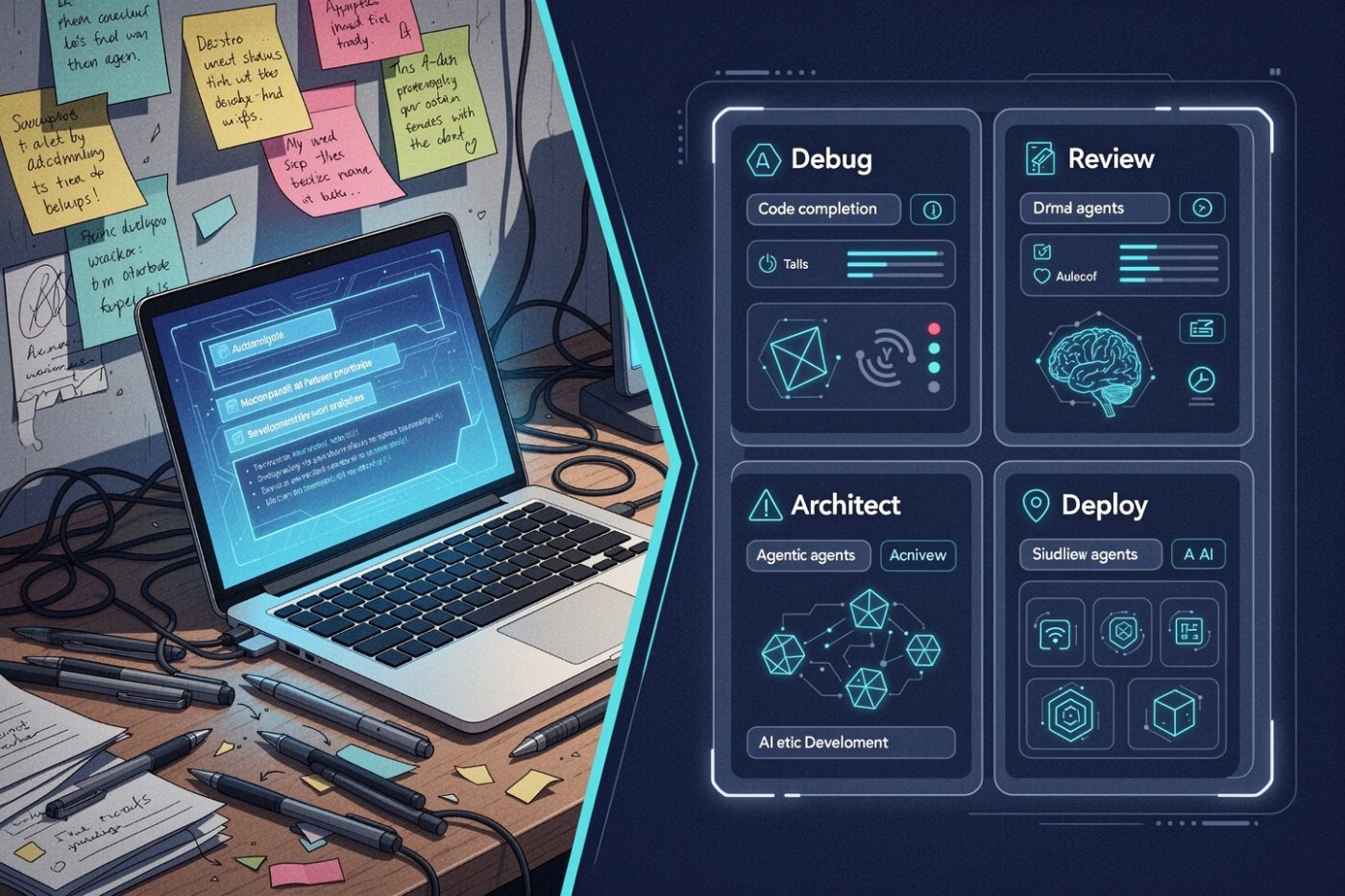
In early 2026, GitHub Copilot crossed 4.7 million paid subscribers—a 75% surge from the previous year—and solidified its position as the most widely adopted AI coding assistant. Yet, despite its dominance in user numbers and a 42% share of the paid market, Copilot’s ability to autonomously resolve real-world software issues remains limited, scoring just 12.3% on the SWE-bench Verified benchmark. This gap between adoption and capability underscores a broader shift in the AI coding assistant landscape: the era of simple code completion is over. The market has bifurcated, with new leaders emerging not by integration or convenience, but by performance on complex, multi-step engineering tasks and reliability in production environments.
What matters now is not just how many developers use a tool, but what they can actually build with it. As AI moves from suggestion engine to active collaborator, benchmarks like SWE-bench Pro—which evaluates agents on realistic, long-horizon tasks such as debugging, refactoring, and feature implementation across multiple files—have become critical. Here, the hierarchy is clear: Claude Opus 5.5 leads with an 89.9% success rate, far outpacing OpenAI’s GPT-5.6 Sol at 64.6%. This performance gap is reshaping enterprise strategy, with companies increasingly adopting specialized toolchains rather than relying on a single “do-it-all” assistant. The result is a more fragmented but higher-performing ecosystem, where trust, accuracy, and architectural reasoning matter more than autocomplete speed.
Market Leaders: Adoption vs. Autonomy
GitHub Copilot remains the default for many organizations, especially those embedded in the Microsoft ecosystem. Its seamless integration with VS Code and GitHub repositories ensures broad appeal, and its presence in 90% of Fortune 100 companies reflects its entrenched position. However, its SWE-bench Verified score of 12.3% reveals a critical limitation: while it excels at line-level suggestions, it struggles with tasks requiring deep codebase understanding or cross-file coordination. This makes it a powerful productivity booster for experienced developers but less effective as an autonomous agent.
In contrast, Cursor has redefined what an AI coding assistant can be. Built as an AI-native IDE, Cursor supports whole-codebase context, enabling it to reason across thousands of files and maintain state during complex development workflows. Its acquisition by SpaceX in August 2026 for $60 billion in an all-stock deal was not just a financial milestone but a strategic signal: AI-driven software development is now central to high-stakes engineering domains, from aerospace to autonomous systems. Despite serving only around 1 million paying users—less than a quarter of Copilot’s base—Cursor generates $2 billion in annual recurring revenue, indicating higher enterprise pricing and deeper integration into critical development pipelines.
Benchmark Performance as a Strategic Metric
The rise of standardized benchmarks has transformed how companies evaluate AI coding tools. SWE-bench Pro, in particular, has gained industry credibility by testing models on actual GitHub issues, requiring them to understand context, write tests, modify multiple files, and produce deployable solutions. The current leaderboard is dominated by Anthropic’s models: Claude Opus 5.5 at 89.9%, followed by Claude Fable 5.1 (81.2%) and Claude Mythos 5 (80.3%). These scores reflect not just raw language understanding but the ability to execute structured, goal-oriented programming tasks with minimal human intervention.
OpenAI’s GPT-5.6 Sol, while still capable in interactive coding sessions, lags significantly at 64.6% on the same benchmark. This performance deficit has real-world implications. Enterprises managing large, legacy codebases or developing safety-critical systems are increasingly favoring tools powered by high-scoring models, even if they require more setup or come at a premium. The benchmark data is now a key input in procurement decisions, with CTOs and engineering leads demanding proof of autonomous capability before approving enterprise-wide deployment.
“We’re no longer buying tools based on demo performance,” said a senior engineering director at a global fintech firm, speaking on background. “We run them through our own version of SWE-bench with anonymized tickets. If it can’t resolve 80% of tier-two incidents autonomously, it doesn’t make the shortlist.”
The Trust Crisis and the Rise of Specialized Toolchains
Despite widespread adoption—85% of developers now use some form of AI coding assistant—trust in their output has plummeted to 29%. This decline is driven by high-profile incidents of AI-generated code introducing security vulnerabilities, breaking production systems, or producing logic errors that evade initial testing. Senior engineers report spending more time reviewing AI suggestions than writing code themselves, undermining the promised efficiency gains.
As a result, the market is shifting toward specialized toolchains. Instead of relying on a single assistant for both code generation and review, teams are layering tools: using GitHub Copilot or Amazon CodeWhisperer for real-time completion, then routing critical changes through AI-powered review systems like Qodo or Sourcegraph Cody. These tools enforce coding standards, perform static analysis, and validate changes against test suites before approval.
“The monolithic AI assistant is becoming obsolete,” said Lena Tran, CTO of a Berlin-based SaaS company. “We use one model for ideation and drafting, another for security scanning, and a third for architectural alignment. It’s like having an AI team, not just an AI pair programmer.” This modular approach allows organizations to mitigate risk while still leveraging AI at scale, particularly in regulated industries such as finance, healthcare, and infrastructure.
Future Trajectories: Consolidation, Specialization, and Agentic Workflows
The $60 billion SpaceX acquisition of Cursor is emblematic of a broader trend: consolidation around platforms that enable true agentic development. Unlike passive assistants that respond to prompts, agentic tools can plan, execute, and verify multi-step tasks with minimal oversight. Cursor’s AI agent, for example, can be given a Jira ticket and will autonomously implement the feature, write tests, and submit a pull request—then respond to feedback and iterate.
This shift is accelerating investment in vertical-specific coding agents. In 2026, startups like DevOpsAI and ChipSynth launched domain-optimized assistants for cloud infrastructure and hardware design, respectively, achieving higher accuracy by narrowing their scope. Meanwhile, open-source initiatives such as StarCoder2-Agent are pushing the boundaries of transparency and customization, appealing to organizations wary of vendor lock-in.
Yet challenges remain. The cost of running high-performance models at scale is prohibitive for many mid-sized firms, and the lack of interoperability between tools creates friction. Industry efforts to standardize agent communication protocols—such as the Open Agent Interface (OAI) framework—are still in early stages.
Looking ahead, the AI coding assistant market will likely continue splitting into two tiers: high-volume, low-autonomy tools for general productivity, and high-cost, high-reliability agents for mission-critical development. The winners will not be those with the most users, but those that can demonstrate consistent, auditable performance on real engineering outcomes. As AI becomes less of a helper and more of a stakeholder in the software lifecycle, the definition of “best” is no longer about convenience—it’s about accountability.
Sources
- 8 Best AI Coding Assistant Tools in 2026 | Hivel
- AI Coding Assistants: Top Picks
- 14 AI Coding Assistant Tools, Tested Across Real Workflows
- 8 Best AI Coding Assistants by Job [Updated August 2026]
- The Best AI Coding Assistants: 20 Tools Reviewed for 2026 - Axify
Written by an AI editorial process from the sources above. Errors may occur.
Newsletter
Get the AI news that matters
One short brief with the day's most important AI stories — written for professionals.
We send a confirmation link. No spam. Unsubscribe anytime.
Read next
AI Coding Assistants in 2026: From Autocomplete to Autonomous Agents
Engineering teams now mix specialized assistants—Copilot, Cursor, Claude Code, Replit, and Qodo—across the delivery pipeline, weighing capability against token costs.
14 Sep 2026
AI Coding Assistants in 2026: No Single Tool Wins
Adoption is mainstream, but high-performing teams now layer IDE assistants, terminal agents, and review platforms instead of betting on one universal tool.
11 Sep 2026
2026 AI Developer Tools: Closing the 78-Point Security Gap
A Checkmarx analysis finds 96% of developers use AI coding tools but only 18% apply continuous security, driving a shift toward autonomous, self-healing fixes inside the IDE.
10 Sep 2026