AI Adoption Hits 72% Production, but the Real Story Is the ROI Gap
Nearly nine in ten organizations now use AI, yet only a minority reach production with measurable returns—and over 40% of agentic projects may be cancelled by 2027.
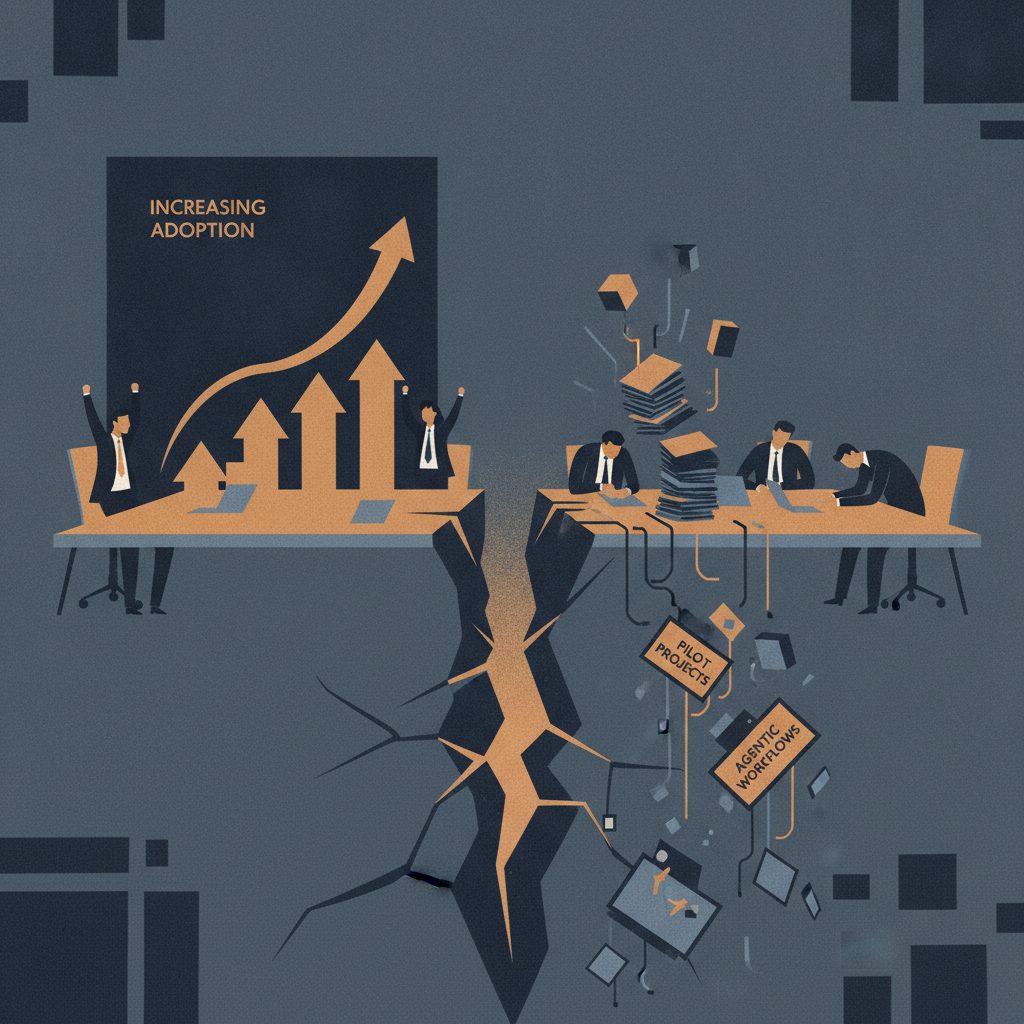
The figure now circulating in boardrooms and strategy decks — that 72% of enterprises have AI in production — is both a milestone and a misreading. It is a milestone because, by the first quarter of 2026, the majority of large organizations genuinely do run at least one artificial intelligence workload in live operations, according to IDC and compilations by independent consultant Paul Okhrem. It is a misreading because the same number is frequently conflated with broader adoption metrics from McKinsey & Company, which show something even larger: 88% of organizations now use AI in at least one business function, and 72% specifically use generative AI. The two 72% figures are not interchangeable: one describes generative AI adoption, the other describes production workloads. The distinction matters more than the headlines suggest.
For executives and founders, the data reveals a critical inflection point. Universal adoption means AI is now a baseline expectation, not a differentiator. When nearly nine in ten organizations use AI somewhere, simply having AI confers no competitive edge. The real competitive advantage lies in moving beyond pilots to production and achieving measurable ROI. The high failure rate of agentic projects underscores the need for robust governance, clear success metrics, and investment in data quality. Organizations that master this transition will compound gains, while those stuck in experimentation risk falling into a laggard gap of wasted capital and lost opportunity.
The numbers behind the headline
McKinsey's 2026 State of AI research, cited across multiple outlets, reports that 88% of organizations use AI in at least one business function, up from 78% the prior year. Within that, 72% use generative AI specifically. The 72% production figure, reported by IDC and echoed in Okhrem's compilation, refers to enterprises with at least one AI workload running in production. The trajectory is steep: adoption climbed from roughly 20% in 2020 to 55% in 2024, reaching the 72% production mark by early 2026.
- 88% adoption: Organizations using AI in any function (McKinsey, 2026), up from 78% the prior year.
- 72% production: Enterprises with at least one AI workload in production (IDC, Paul Okhrem citing McKinsey).
- 31% agent deployment: Only 31% of enterprises run at least one AI agent in production (S&P Global, McKinsey via Paul Okhrem).
- 40% cancellation risk: Gartner predicts over 40% of agentic AI projects will be canceled by 2027.
But the headline adoption rate obscures a much more uneven reality beneath it. When the lens narrows to agentic AI — systems that execute tasks autonomously rather than merely assisting a human — the numbers drop sharply. According to S&P Global and McKinsey data cited by Okhrem, only 31% of enterprises run at least one AI agent in production. That is less than half the overall AI production rate. Okhrem, an independent AI decision consultant and fractional chief AI officer, notes that while 80% of enterprise applications are forecast to embed an agent by year-end, the current production deployment rate of 31% underscores the difficulty of operationalizing autonomous systems.
The shift from assistive to agentic AI is the key driver of the current wave. Assistive systems suggest, draft, or classify; agentic systems plan, execute, and complete tasks with limited human intervention. That difference is central to both the adoption surge and the operational risk. Gartner and McKinsey are the primary sources for most of these statistics, with Gartner focusing on project failure risks and McKinsey on broad adoption trends.
The ROI gap
A second figure circulating alongside the adoption data — an 88% return on investment for agentic systems, highlighted by LinkedIn commentator Bill McCabe — has been widely repeated but is not a universal average. McKinsey's research reports an average return of 3.7x on AI investments, but that headline number masks a wide spread. Even among frontier firms the cited figure is 2.84x ROI, while laggards fall below break-even. Only 6% of organizations qualify as AI high performers with significant profit impact, and just 39% report any EBIT impact from AI at all.
The gap between adoption and value realization is the central tension of the 2026 landscape. An organization can be counted in the 88% adoption statistic and still be losing money on its AI initiatives. McCabe's emphasis on the 72% adoption figure and the 88% ROI rate — while directionally aligned with the broader trend — risks flattening a distribution that is far more dispersed than a single percentage suggests. For decision-makers, the relevant question is not whether they are using AI, but whether they are in the frontier cohort or the laggard cohort.
The cancellation forecast
Gartner has issued one of the more sobering predictions in this space: more than 40% of agentic AI projects will be canceled by 2027. The forecast, attributed to Anushree Verma, a Senior Director Analyst at Gartner, is based on a 2025 poll and cites unclear ROI, escalating costs, and inadequate risk controls as the primary drivers of failure. The prediction has been widely reported and has become a reference point for boards weighing new agentic investments.
This forecast does not contradict the adoption numbers — it explains their fragility. Widespread adoption without corresponding governance creates exactly the conditions Gartner describes: projects that scale in cost before they scale in value, with risk controls lagging behind autonomy. The 40% cancellation rate is not a ceiling on agentic AI's potential; it is a warning about how much of the current wave is built on experimentation rather than operational discipline.
What separates the frontier from the laggards
The data points to a clear dividing line. Organizations that move beyond pilots and into production with measurable ROI share several characteristics: they invest in data quality before deployment, they define success metrics before scaling, and they build governance frameworks that keep pace with the autonomy of agentic systems. Those stuck in experimentation — running many pilots but few production workloads — risk what the research implies is a laggard gap: capital spent without compounding returns.
Okhrem's observation that 80% of enterprise applications are forecast to embed an agent by year-end, while only 31% are currently in production, captures the transition risk. The forecast assumes a smooth path from embedding to deployment. The current reality suggests that path is anything but smooth. The organizations that close that gap — that turn embedded capability into deployed, governed, profitable operation — will be the ones that capture the compounding gains the frontier firms already demonstrate.
The 72% production figure, then, is best understood not as proof of success but as evidence of scale. The harder work — converting scale into value — is only beginning. For global executives, the 2026 data offers a clear mandate: treat AI adoption as table stakes, and treat governance, data quality, and ROI discipline as the actual competitive arena. The next twelve to eighteen months will determine which organizations join the 6% of high performers and which ones contribute to Gartner's cancellation statistic.
Sources
- Agentic AI Enterprise Adoption 2026: 72% Production Proven
- Agentic AI in 2026: The Autonomous Revolution Reshaping Enterprise Tech
- Enterprise AI Agent Stats 2026: 80% Embed, 31% Deploy
- Enterprise AI Adoption Surges to 72% with 88% ROI
- Agentic AI Adoption Statistics for 2026 - First Page Sage
Written by an AI editorial process from the sources above. Errors may occur.
Newsletter
Get the AI news that matters
One short brief with the day's most important AI stories — written for professionals.
We send a confirmation link. No spam. Unsubscribe anytime.
Read next

Autonomous AI Agents Become Core Enterprise Infrastructure in 2026
The market for autonomous AI agents is projected to surge from $7.92 billion in 2025 to $236.03 billion by 2034, as enterprises shift from experimentation to governing systems that perform operational work.
14 Sep 2026
Enterprise AI’s 2026 Roadmap Splits Between Knowledge and Governance
Enterprise AI World in Washington and The AI Enterprise Conference in New York lay out complementary paths from pilots to production—one focused on knowledge and culture, the other on governance and ROI.
14 Sep 2026
Pharma’s AI Shift: From Pilot Projects to Core Drug Discovery
At a London industry conference, pharma leaders showed how generative AI, LLMs and autonomous labs are becoming operational R&D tools—while data quality and regulation lag behind.
14 Sep 2026