Waymo Robotaxi Loops for Five Minutes With Passenger Unable to Exit
A software glitch trapped a Waymo passenger in a five-minute loop near LAX, raising urgent questions about remote intervention, passenger control, and regulatory oversight as robotaxi fleets expand.
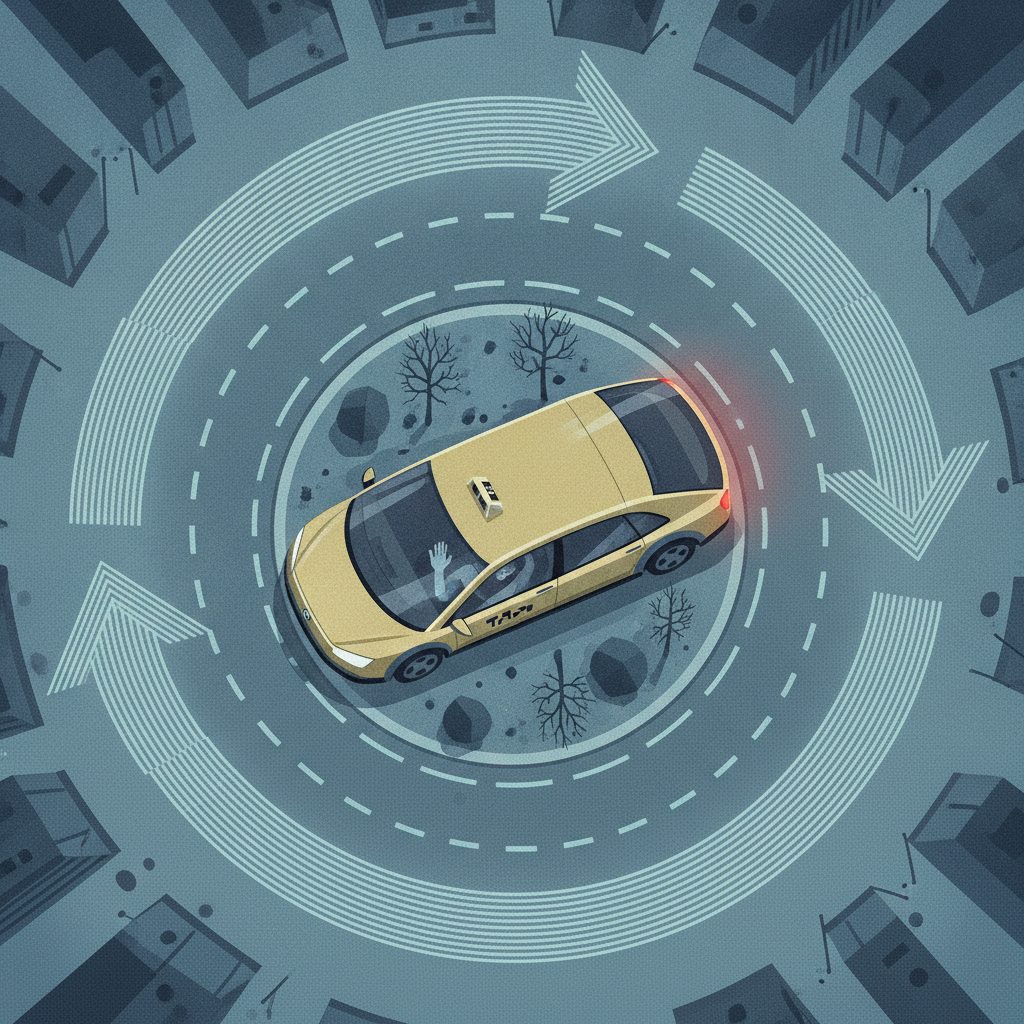
In December 2024, a Waymo robotaxi passenger in Los Angeles experienced a stark demonstration of how a single software glitch can turn a routine airport transfer into a disorienting loop. Mike Johns had summoned a self-driving Jaguar I-Pace and was en route to catch a flight when the vehicle began circling a traffic island near the pickup point. For approximately five minutes, the car repeated the same path instead of following its planned route, while Johns filmed the incident from inside. He could not take manual control, and the vehicle only resumed its journey after Waymo’s remote support team intervened. Johns ultimately reached the airport, but the episode has become a widely cited case study in the fragility of autonomous vehicle operations.
The incident matters beyond one passenger’s frustration. It exposes the gap between the polished promise of driverless mobility and the unpredictable edge cases that still occur on public roads. For technology executives, mobility operators, and risk managers, the looping robotaxi is not just a viral video; it is a reminder that complex AI-driven systems can fail in ways that are confusing, frightening, and difficult to escape. As autonomous fleets expand across cities in the United States and other markets, such failures raise urgent questions about software resilience, remote intervention, and passenger trust.
Five minutes in a loop: what happened inside the vehicle
According to Waymo, the December 2024 incident was caused by a software glitch. The company confirmed the problem and said it has since been resolved through a software update designed to prevent recurrence. Waymo also waived the fare for the disrupted ride. But for Johns, the experience was alarming. He questioned whether the car had been hacked and emphasized that he had no way to exit the vehicle while it was moving. In comments to CBS News, he later described the service as a “half-baked product”, criticizing what he saw as a lack of human empathy in the automated system.
The inability of a passenger to override the vehicle or easily stop the loop highlights a design tension in autonomous taxis. Unlike a traditional taxi, where a passenger can ask the driver to pull over, a robotaxi passenger is dependent on remote operators and software safeguards. In this case, the remote support team did regain control, but the delay of approximately five minutes may feel much longer to a passenger who is unsure whether the car is being controlled, hacked, or simply malfunctioning. The fact that Johns was headed to the airport added time pressure and stress, but the underlying issue could affect any rider in any location.
Johns documented the experience from inside the vehicle, and his recording captured both the repetitive movement and his own alarm. The footage shows a passenger who cannot exit a moving car and cannot communicate with a human driver. That combination of confinement and uncertainty is particularly difficult for riders who are accustomed to the immediate feedback of a human driver. In a conventional taxi or ride-hailing vehicle, a passenger can ask a question, request a stop, or at least read the driver’s reaction. In a robotaxi, the passenger’s options are limited, and those may not be sufficient when the vehicle is stuck in a loop.
A pattern of unusual robotaxi behavior
The Los Angeles looping incident is not an isolated anomaly. In August 2024, multiple Waymo robotaxis gathered and honked repeatedly in a San Francisco parking lot, creating noise complaints and drawing public attention to the vehicles’ behavior when they encounter ambiguous situations. That event, like the circling Jaguar, involved vehicles responding to their environment in ways that were technically safe but socially disruptive or confusing. Such edge cases are difficult to anticipate in simulation and often emerge only when vehicles operate at scale in real cities.
Waymo has acknowledged the San Francisco honking issue and adjusted its software, but the pattern points to a broader challenge: autonomous systems can behave correctly according to their programming while still failing in the eyes of users and bystanders. For fleet operators, the lesson is that reliability is not only about avoiding collisions. It also means avoiding repetitive loops, unnecessary honking, blocked driveways, and other behaviors that erode public tolerance for autonomous vehicles.
The two incidents share a common feature: vehicles encountered conditions that their software did not handle gracefully. In Los Angeles, a traffic island triggered a repeated path. In San Francisco, a parking lot situation led to gathering and honking. Neither event caused a collision, but both generated negative public attention. For companies scaling autonomous fleets, these non-collision failures can be as damaging as crashes because they shape public perception and invite regulatory interest.
Regulatory scrutiny and the remote intervention gap
The incidents are occurring against a backdrop of formal regulatory review. The National Highway Traffic Safety Administration (NHTSA) is currently investigating crashes involving Waymo’s autonomous vehicles, underscoring that safety regulators are paying close attention to real-world performance, not just laboratory results. While the December 2024 looping event did not result in a crash, it falls into a category of operational failures that regulators may consider when assessing the safety culture and remote oversight capabilities of autonomous vehicle companies.
Remote intervention is a critical part of the safety architecture for driverless taxis. When a vehicle encounters a situation it cannot resolve, a human operator can take control or issue guidance. But the Los Angeles case shows that remote support is not instantaneous. The vehicle circled for approximately five minutes before the remote team regained control. During that time, the passenger had no direct way to stop the car. This gap between failure detection and human intervention is a key vulnerability. As fleets scale, the ratio of remote operators to vehicles will be tested, and delays could become more common unless software can detect and exit failure states more quickly.
The NHTSA investigation covers crashes, not every operational anomaly, but the looping incident adds to a record that regulators and city officials may review when deciding whether to expand permits. For international professionals in technology, mobility, and risk management, this case underscores the fragility of complex AI-driven systems in real-world conditions. Despite advances, edge-case failures can erode user trust and expose gaps in remote intervention protocols.
Trust, design, and the road to scaled autonomy
Johns’s criticism of the service as a “half-baked product” reflects a deeper issue: technical competence alone does not build public trust. Passengers need to feel that they can understand what the vehicle is doing, communicate with a human when something goes wrong, and exit safely if necessary. The absence of a human driver removes a familiar source of reassurance. In its place, companies must provide clear in-cabin communication, reliable emergency controls, and rapid human support. The looping robotaxi offered none of these during the most stressful minutes of the ride.
For the broader autonomous vehicle industry, the lesson is that edge-case failures are not merely engineering bugs to be patched. They are trust events. Each viral video of a robotaxi behaving strangely can influence public opinion and regulatory appetite, even if the underlying safety statistics remain strong. Companies that invest in human-centered design, transparent incident reporting, and robust remote operations may be better positioned to weather these moments. Those that treat them as isolated glitches risk a slower path to public acceptance.
For international professionals in technology, mobility, and risk management, the case highlights three priorities:
- Software resilience: systems must detect and exit failure states without prolonged loops.
- Transparent incident response: companies need clear communication and rapid remote intervention.
- Human-centered design: passengers require understandable in-cabin information and reliable ways to get help.
Looking ahead, the December 2024 incident in Los Angeles is likely to be cited in safety reviews, investor discussions, and product design meetings. Waymo has said the software glitch is fixed and the fare was waived, but the deeper questions remain: how quickly can a remote operator take control, how clearly can a passenger call for help, and how well do autonomous systems handle the messy, unscripted realities of city streets? As robotaxi services expand to more cities and more riders, the industry’s ability to answer those questions will determine whether self-driving taxis become a trusted utility or remain a curiosity with a persistent edge-case problem.
Sources
Written by an AI editorial process from the sources above. Errors may occur.
Newsletter
Get the AI news that matters
One short brief with the day's most important AI stories — written for professionals.
We send a confirmation link. No spam. Unsubscribe anytime.
Read next
The State of AI Security and Governance in 2026
As AI becomes embedded in core operations, security and governance gaps expose organizations to rising threats and regulatory risks.
28 Sep 2026
EU and U.S. AI Regulation Diverge in 2026
The EU enforces strict, rights-based AI rules while the U.S. embraces fragmented state-level policies, creating a transatlantic compliance divide.
23 Sep 2026
EU vs. U.S. State AI Laws: Compliance in a Divided Regulatory World
The EU’s binding AI Act contrasts sharply with the U.S.’s fragmented state laws, creating complex challenges for global businesses navigating divergent rules on risk, transparency, and enforcement.
22 Sep 2026