Self-Driving Car Laws Diverge as UN Standard Takes Shape
Driverless rides are already available in San Francisco, Wuhan, and Germany, but each operates under different legal regimes. A new UN draft regulation aims to harmonize safety standards across markets.
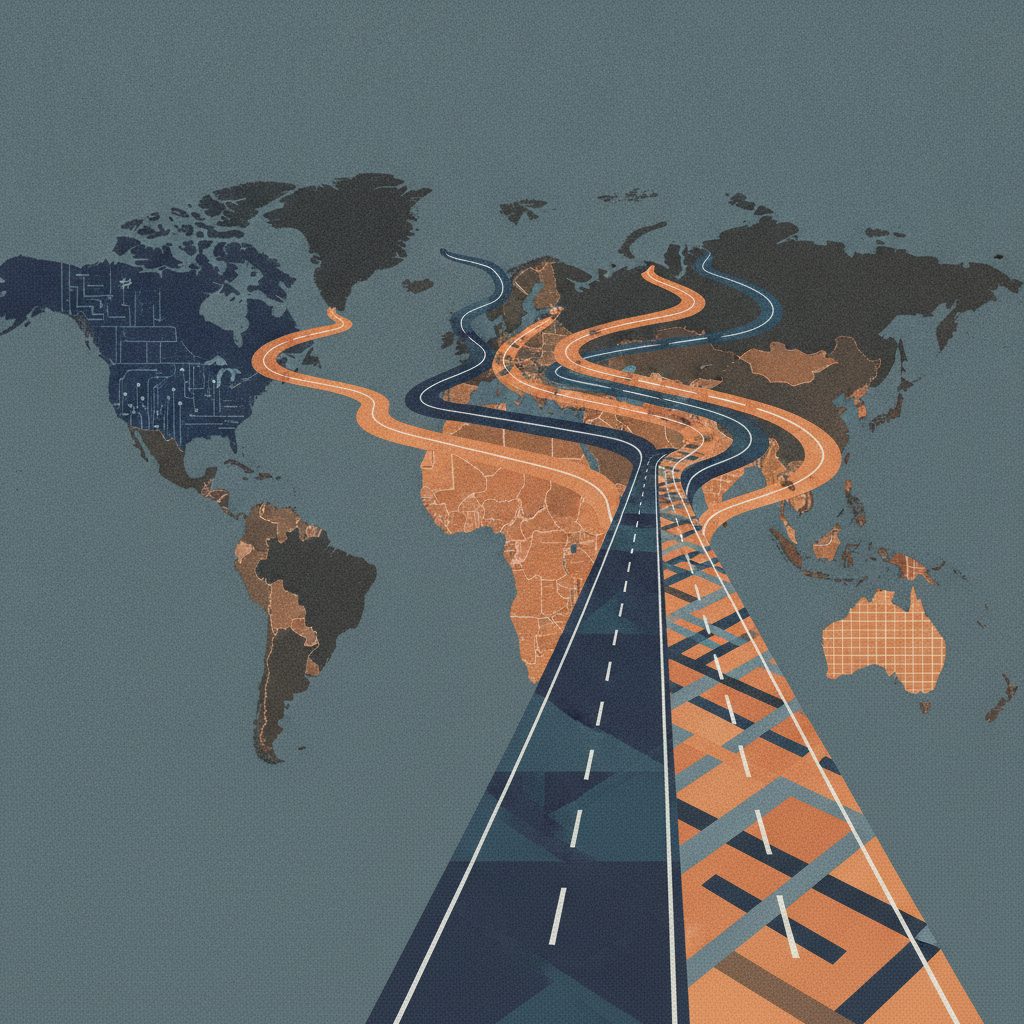
By early 2026, a passenger in San Francisco can summon a driverless Waymo, a resident of Wuhan can ride in a Baidu Apollo Go robotaxi, and a logistics operator in Germany can deploy a Level 4 shuttle without a human behind the wheel. Each trip is governed by a different legal regime, with different liability rules, safety evidence requirements and operational limits. The global market for automated driving is expanding through a fragmented set of national and state frameworks that are only slowly converging around a draft United Nations standard.
The stakes are high for manufacturers, fleet operators and investors. Regulatory divergence can force companies to run separate engineering, testing and compliance programmes for each market, while a credible safety framework can unlock commercial passenger services. The UNECE draft Global Technical Regulation on Automated Driving Systems, adopted in January 2026, is the clearest attempt yet to bridge Europe’s type-approval model and the self-certification approach used in the United States and Canada.
Level 2 driver-assistance systems, which require a human driver to monitor the road, remain broadly legal under existing vehicle safety rules. The legal frontier is Level 3 conditional automation and Level 4 driverless operation, where responsibility shifts from the driver to the manufacturer or operator.
Germany and the UK set the legal template
Germany enacted the world’s first comprehensive Level 4 law in 2021, allowing driverless operation in defined areas. The law assigns liability to the manufacturer’s technical supervisor, creating a clear chain of responsibility that other jurisdictions have studied. The UK’s Automated Vehicles Act 2024 is being implemented in phases: regulations protecting marketing terms for automated vehicles are expected in early 2026, and commercial automated passenger services without a safety driver are set to launch in spring 2026, according to the UK government.
These frameworks differ in detail. Germany’s approach is tied to specific operational design domains and a supervisory role, while the UK is building a broader authorisation scheme for automated passenger services. Both, however, treat Level 4 as a regulated service rather than a conventional vehicle, requiring operators to demonstrate safety before deployment.
The United States: state-level momentum, federal ambiguity
In the United States, 21 states allow autonomous vehicle operations, with California, Arizona and Texas serving as key hubs for Waymo and Cruise robotaxis. Unlike the European Union and Japan, which rely on type approval, the U.S. system is built on self-certification for vehicle safety. That creates a two-track reality: states control road access, insurance and operational permits, while federal regulators set vehicle safety standards through a less prescriptive process.
This state-by-state model has enabled rapid commercial deployment in cities such as Phoenix and San Francisco, but it also means that a company’s legal obligations can change at a state border. The absence of a single federal framework for Level 4 operations remains a structural challenge for national scaling.
China’s high-volume test bed hits a regulatory reset
China has pushed aggressive deployment of robotaxis, with Baidu’s Apollo Go operating in multiple cities and Wuhan hosting one of the largest robotaxi fleets in the world. In the first quarter of 2026, Apollo Go reported 3.2 million fully driverless rides, a 120 percent year-on-year increase. That scale is unmatched in most Western markets.
But a March 2026 incident involving nearly 100 stranded vehicles triggered a regulatory “cooling-off” period, restricting new deployments through mid-2026, as reported by CarNewsChina on 29 May 2026. The episode shows that even the most advanced commercial operators face operational and public trust risks that can quickly become regulatory constraints. Industry leaders such as WeRide and Pony.ai have responded by calling for a different approach.
WeRide and Pony.ai have urged regulators to adopt “performance-based, differentiated regulation” rather than blanket restrictions, citing aviation safety models.
Their argument is that safety outcomes, not rigid deployment caps, should determine which operators can expand. That position is likely to shape the next phase of China’s rule-making as the cooling-off period expires.
A global benchmark takes shape
The UNECE draft Global Technical Regulation on Automated Driving Systems, adopted in January 2026 and expected to be finalised by June 2026, introduces a Safety Management System, safety case requirements and in-service monitoring. The goal is to harmonise safety standards across markets that use type approval, such as the EU and Japan, and those that use self-certification, such as the U.S. and Canada.
For executives and founders, the emerging framework could reduce duplication. A company that builds a safety case once could, in theory, use it across multiple jurisdictions, even if local road-access rules remain separate. That would be a meaningful shift from today’s fragmented compliance burden. The UNECE framework is not a binding global law, but it is the most detailed multilateral attempt to define what a safe automated driving system looks like across different regulatory traditions.
The regulatory cooling-off in China is a reminder that scale alone does not guarantee public acceptance. Companies with strong safety records and transparent operational data — such as Baidu and Pony.ai, according to industry analysts — are better positioned to gain regulatory approval and rebuild trust after incidents. The UNECE framework’s emphasis on in-service monitoring aligns with that logic: it rewards operators that can demonstrate continuous safety performance, not just initial approval.
As the UNECE GTR moves toward finalisation in June 2026, the next 12 months will test whether a global safety benchmark can coexist with national deployment rules. Germany and the UK are already translating high-level principles into operational authorisations, while U.S. states continue to compete for robotaxi investment and China balances scale with stability. For global operators, the strategic challenge is no longer whether autonomous driving is legal somewhere, but whether a company can build a safety case and operational record that travels across borders.
Sources
- 🤖 Self-Driving Car Laws 2026 — L2–L4 Rules by Country | TyreMap
- Vehicles Licensed for the first time July 2026
- Immigration Rules archive: 20 June 2022 to 28 June 2022
- Self-Driving Cars Will Be Ready Before Our Laws Are
Written by an AI editorial process from the sources above. Errors may occur.
Newsletter
Get the AI news that matters
One short brief with the day's most important AI stories — written for professionals.
We send a confirmation link. No spam. Unsubscribe anytime.
Read next

The State of AI Security and Governance in 2026
As AI becomes embedded in core operations, security and governance gaps expose organizations to rising threats and regulatory risks.
28 Sep 2026
EU and U.S. AI Regulation Diverge in 2026
The EU enforces strict, rights-based AI rules while the U.S. embraces fragmented state-level policies, creating a transatlantic compliance divide.
23 Sep 2026
EU vs. U.S. State AI Laws: Compliance in a Divided Regulatory World
The EU’s binding AI Act contrasts sharply with the U.S.’s fragmented state laws, creating complex challenges for global businesses navigating divergent rules on risk, transparency, and enforcement.
22 Sep 2026