Microsoft AI Chief Aims to Make Company the Fourth Frontier Lab
Mustafa Suleyman declares Microsoft will build proprietary AI models to end reliance on OpenAI, signaling a shift toward vertical integration.
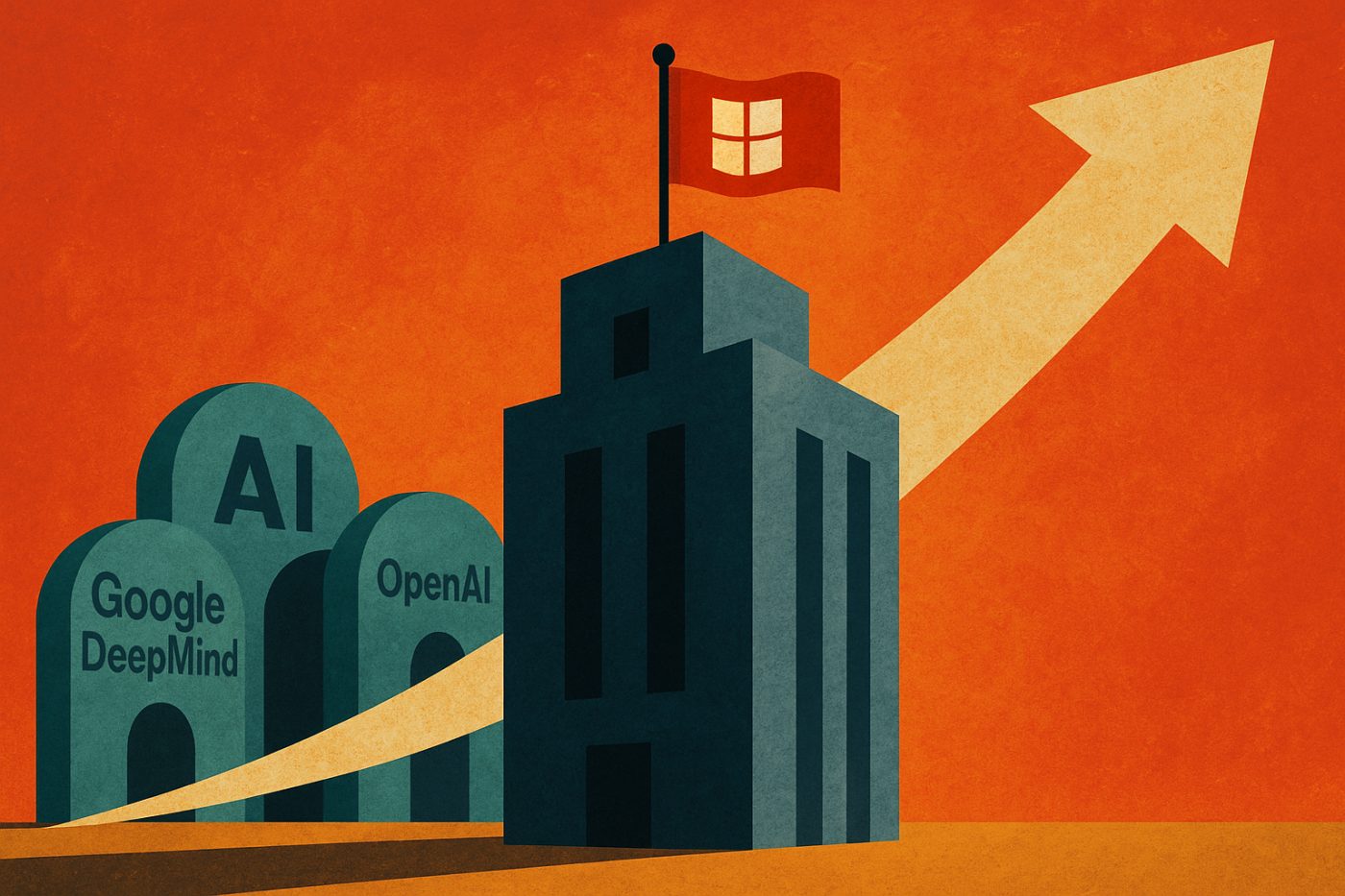
At Microsoft Build 2026, held on June 3, AI chief Mustafa Suleyman delivered a blunt assessment: only three labs currently define the frontier of artificial intelligence—Google DeepMind, OpenAI, and Anthropic—and his explicit mission is to make Microsoft the fourth. Suleyman, a co-founder of DeepMind who joined Microsoft in 2024 as Executive VP and CEO of Microsoft AI, declared that the company will no longer rely on external partners for its most advanced capabilities. Instead, Microsoft is building proprietary models "from the ground up," complete with their own intellectual property and training data, to end its long-standing dependence on OpenAI’s technology. The announcement represents a strategic inflection point for the tech giant, which had previously anchored its AI ambitions in a deep partnership with OpenAI but now seeks full sovereignty over its frontier systems.
The move carries broader implications for the AI industry. For years, enterprises have depended on a small cohort of external model providers, but Microsoft’s push for vertical integration—encompassing custom silicon, proprietary models, and deep integration with its own software ecosystem—signals a fracturing of the AI supply chain. According to Suleyman, global adoption of coding and generalist reasoning models remains "less than 1%," suggesting that the real battle for market share has barely begun. The company’s bet is that future competitive advantage will lie not just in raw model capability, but in cost efficiency, enterprise trust, and end-to-end ownership of the AI stack.
A Six-Month Sprint: Microsoft’s Break from OpenAI
Microsoft’s separation from OpenAI, effectively finalized in late April 2026, served as the catalyst for this shift. Though Microsoft remains OpenAI’s primary cloud partner for the foreseeable future, Suleyman’s team has spent the past six months in an intensive push to develop in-house alternatives. The result was the unveiling of MAI-Thinking-1, Microsoft’s first reasoning model built entirely from scratch, alongside six additional new models covering image generation, voice synthesis, transcription, and coding. The launch comes years after competitors entered the space—OpenAI released its first reasoning models in fall 2024—but Suleyman frames the delay as an opportunity to learn from early missteps and deliver more refined solutions.
Central to Microsoft’s technical strategy is a rejection of "distillation," the practice of training models on the outputs of other models, which competitors like DeepSeek have employed to accelerate development cycles. Suleyman insists that Microsoft’s models are trained on raw, proprietary data, a choice he argues ensures higher quality, better long-term scalability, and stronger intellectual property protections. However, this approach also means Microsoft is playing catchup in a field where rivals have already established dominance. As Suleyman himself acknowledged in interviews, "We are in the greatest game of catchup ever played."
The stakes are high. While Microsoft has long been a leader in cloud infrastructure and enterprise software, its late entry into the reasoning model and agent framework space puts it behind not only OpenAI and Anthropic but also newer players like Cursor. The company’s ability to close this gap will depend on the performance of its new models, the speed of its iteration cycles, and its capacity to integrate these technologies into workflows where they can deliver tangible value.
Vertical Integration: Custom Chips, Proprietary Models, and Enterprise Tools
Microsoft’s bid for AI sovereignty extends far beyond model development. The company is investing in custom accelerator chips to optimize performance and reduce costs, a move that echoes Nvidia’s dominance in AI hardware but tailors it specifically to Microsoft’s needs. Jensen Huang, Nvidia’s CEO, has publicly endorsed this direction, highlighting the RTX Spark chip as a key enabler for Microsoft’s AI agent ambitions. By controlling the hardware layer, Microsoft aims to create a more efficient, lower-cost infrastructure for training and deploying its models at scale.
On the software side, Microsoft is tightly integrating its new models with its existing developer tools. GitHub Copilot and VS Code are being positioned as the "home base" for software development, with models fine-tuned to work seamlessly within these environments. Cassidy Williams, GitHub’s Senior Director of Developer Advocacy, demonstrated during Build 2026 how Copilot now serves as a unified interface for coding, debugging, and deployment, reducing friction for developers and accelerating workflows. The goal is to make Microsoft’s AI tools indispensable to the millions of developers who already rely on its platforms.
Beyond coding, Microsoft introduced a suite of autonomous AI agents under the "Autopilots" brand. These long-running agents are designed for enterprise use and include compliance features tailored to large-scale deployments. The first agent, "Scout", functions as a personal, always-on assistant, while MDASH is a cybersecurity tool that deploys 100 AI agents to identify and remediate exploitable bugs in code. These offerings place Microsoft in direct competition with Anthropic’s Claude Mythos and OpenAI’s own cybersecurity systems, signaling a new front in the battle for enterprise AI adoption.
Market Realities: Adoption Challenges and Investor Skepticism
Despite the technical progress and strategic vision, Microsoft faces significant headwinds. The company’s shares were down 16% year-to-date as of early June 2026, with investors expressing growing concern over intensifying AI competition and the slower-than-expected penetration of Copilot. Suleyman has repeatedly emphasized that benchmark performance alone is meaningless without real-world adoption, underscoring the challenge ahead: even the most advanced models are worthless if users and enterprises do not embrace them at scale.
Internal tensions have further complicated the transition. Reports indicate that Microsoft cut off employee access to Claude Code in some divisions, a move intended to drive internal adoption of Copilot. However, the decision was met with criticism from staff, who viewed it as a cost-cutting measure rather than a genuine improvement to the product. The episode highlights the difficulty of transitioning an organization of Microsoft’s size away from established tools, even when the strategic rationale is clear. For a company that has long prided itself on its developer-first ethos, forcing a switch to in-house tools risks alienating the very users it seeks to serve.
Externally, Microsoft’s late entry into the reasoning model and agent framework space remains a point of vulnerability. Suleyman’s estimate that less than 1% of the global market has adopted these technologies suggests there is still time to gain ground, but the window is closing rapidly. Competitors like OpenAI, Anthropic, and Cursor have already established strong footholds, and Microsoft will need to demonstrate clear differentiation to win over users. Satya Nadella, Microsoft’s CEO, has framed the separation from OpenAI as a "new opportunity," but the company’s ability to capitalize on it will depend on rapid execution, compelling product offerings, and a convincing value proposition for enterprises.
Industry Reactions and the Road Ahead
The announcements at Build 2026 were not made in a vacuum. Peter Steinberger, the creator of the open-source agent platform OpenClaw and a recent hire by OpenAI, made a surprise appearance during the event to discuss enterprise security. His presence served as a stark reminder of the competitive dynamics at play, underscoring that Microsoft is not the only company vying for dominance in AI agents and workflow integration. The fact that OpenAI chose to engage directly at Microsoft’s flagship developer conference speaks to the high stakes of the current moment in AI.
For enterprise leaders, Microsoft’s pivot raises a series of critical questions. Will its proprietary models outperform those of OpenAI and Anthropic in real-world scenarios, particularly in specialized domains like coding, cybersecurity, and business automation? Can its vertical integration strategy deliver the cost efficiencies and reliability needed to win over large-scale deployments? And how will its cybersecurity tools, like MDASH, compare to established alternatives in terms of effectiveness and ease of use?
What is already clear is that Microsoft is placing a massive bet on control. By owning the entire stack—from custom chips to proprietary models to deeply integrated applications—the company aims to reduce dependencies, improve margins, and offer enterprises a single, trusted provider for their AI needs. This approach carries risks, including the potential for higher upfront costs and the challenge of maintaining pace with specialized competitors. But if successful, it could redefine the competitive landscape, shifting the balance of power from standalone AI labs to hyperscalers with end-to-end ownership of their AI infrastructure.
As the AI landscape continues to evolve, one thing is certain: the era of relying on a single external partner for frontier models is drawing to a close. The next chapter will be defined by sovereignty, integration, and the race to turn cutting-edge research into indispensable tools for the global economy. For Microsoft, the path forward is fraught with challenges, but the potential rewards—market leadership, enterprise trust, and long-term competitive advantage—are immense. Whether the company can execute on its ambitious vision remains an open question, but the stakes could not be higher.
Sources
- Microsoft AI chief Mustafa Suleyman says there are three labs that matter — and he wants Microsoft to be the fourth.
- Microsoft’s AI chief on the greatest game of catchup ever played
- The dilemmas of delegation
- People
Written by an AI editorial process from the sources above. Errors may occur.
Newsletter
Get the AI news that matters
One short brief with the day's most important AI stories — written for professionals.
We send a confirmation link. No spam. Unsubscribe anytime.
Read next

The AI Cloud Race: Big Tech's $130B Power Play
Amazon, Microsoft, and Alphabet are spending billions to dominate AI through cloud infrastructure, reshaping global tech, security, and market dynamics.
19 Sep 2026
AI Inference Market to Hit $255B by 2030
Global demand for real-time AI decision-making drives explosive growth in inference infrastructure, with NVIDIA, Intel, and Siemens Healthineers leading diverse applications.
18 Sep 2026
Autonomous AI Agents Become Core Enterprise Infrastructure in 2026
The market for autonomous AI agents is projected to surge from $7.92 billion in 2025 to $236.03 billion by 2034, as enterprises shift from experimentation to governing systems that perform operational work.
14 Sep 2026