How Self-Driving Cars Work and the Road to Full Autonomy
Autonomous vehicles use AI, sensors, and real-time systems to navigate—but technical, ethical, and regulatory hurdles remain on the path to full automation.
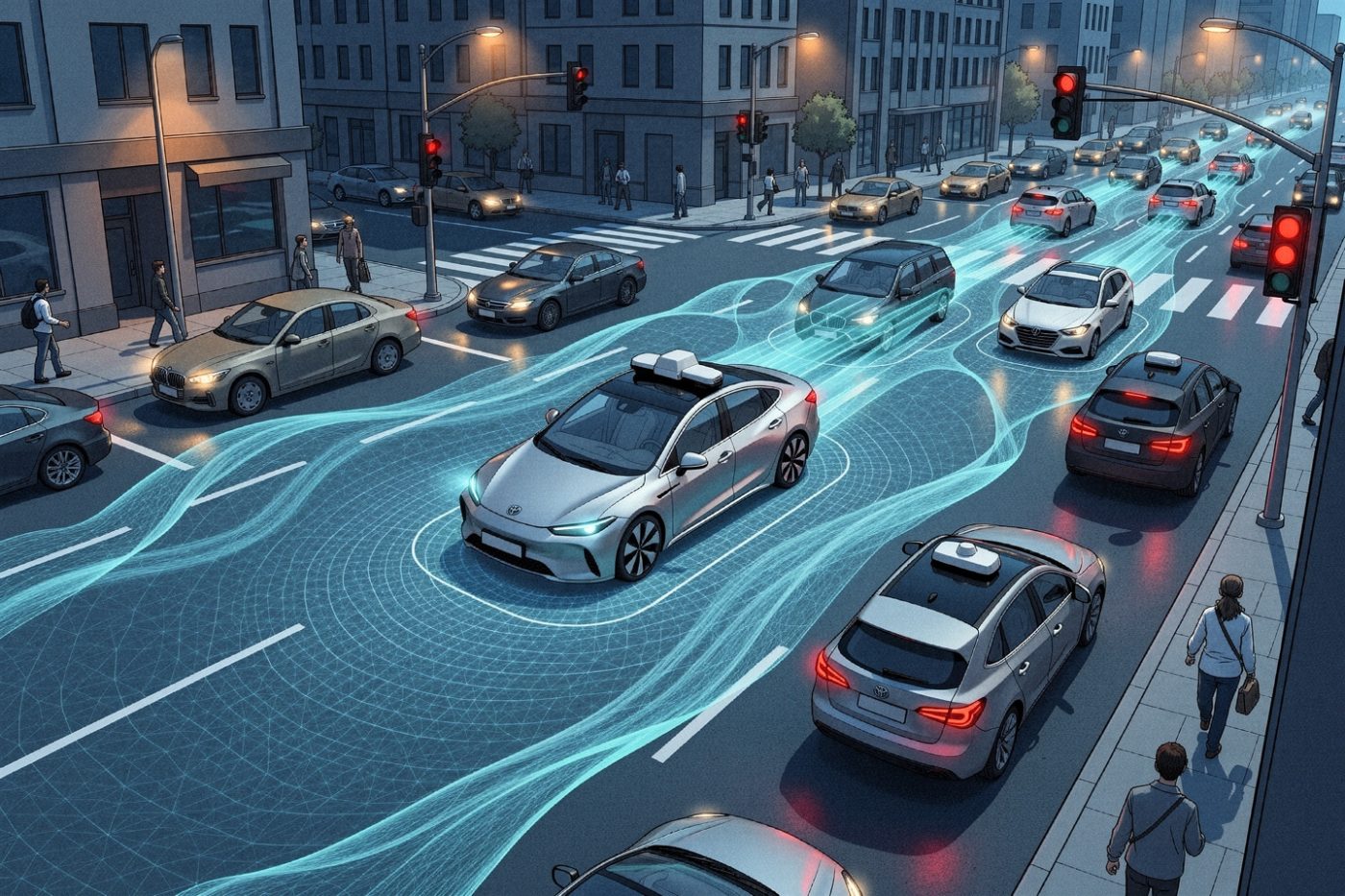
Autonomous vehicles (AVs) are no longer science fiction. They are navigating city streets, ferrying passengers, and reshaping the future of mobility. At their core, AVs use a combination of advanced sensors, artificial intelligence (AI), and real-time software systems to perceive their environment, make decisions, and drive without human intervention. The technology is guided by a globally recognized framework—the SAE International J3016 standard—which defines six levels of driving automation, from Level 0 (no automation) to Level 5 (full automation under all conditions). As of 2026, most consumer vehicles offer Level 2 capabilities, where systems like Tesla Autopilot can simultaneously manage acceleration, braking, and steering, but still require constant driver attention. True autonomy—where humans are no longer needed behind the wheel—remains largely confined to controlled environments and specific geographic zones.
Understanding how self-driving cars work matters not just for engineers and policymakers, but for executives, urban planners, and business leaders navigating a transformation in transportation, logistics, and infrastructure. The rise of AVs signals a convergence of AI, electrification, and shared mobility that could redefine entire industries. Yet, despite rapid progress, significant technical, ethical, and regulatory challenges remain. Safety, equity, environmental impact, and public trust are not just footnotes—they are central to the viability of autonomous mobility at scale.
How Autonomous Vehicles Navigate the World
Self-driving cars rely on a layered technological stack often referred to as the "self-driving stack." This includes perception, localization, planning, and control systems, all operating in real time. At the perception layer, vehicles use a suite of sensors—cameras, radar, lidar, and ultrasonic detectors—to create a 360-degree view of their surroundings. Cameras capture visual details like traffic signs and lane markings, while radar detects objects in poor visibility. Lidar, which uses laser pulses to map distances, provides high-resolution 3D spatial data, critical for identifying obstacles and navigating complex urban environments.
Once the vehicle perceives its environment, it must determine its precise location. This is achieved through high-definition maps and simultaneous localization and mapping (SLAM) algorithms, which compare real-time sensor data with pre-mapped environments. GPS alone is insufficient for centimeter-level accuracy; instead, AVs fuse GPS with inertial measurement units and map data to achieve reliable positioning. With location and surroundings established, the planning system takes over, using AI models to predict the behavior of other road users and generate safe, legal trajectories. Finally, the control system executes these decisions by adjusting steering, acceleration, and braking.
The entire process happens in milliseconds, requiring immense computational power. Companies like Mobileye, NVIDIA, and Synopsys develop specialized chips and software platforms to handle this workload efficiently. But hardware and software are only part of the equation—the real challenge lies in training AI models to handle the infinite variability of real-world driving.
From Levels 0 to 5: The Road to Full Autonomy
The SAE J3016 standard provides a clear taxonomy for understanding the progression of automation. Level 0 involves no driver assistance, while Level 1 introduces basic functions like adaptive cruise control. Level 2, now common in vehicles from Tesla, GM, and Ford, enables partial automation of lateral and longitudinal control, but the driver must remain engaged at all times. Level 3 marks a pivotal shift: in specific conditions, such as highway driving or traffic jams, the vehicle can assume full responsibility, allowing the driver to disengage—though they must be ready to take over when prompted.
Level 4 is where true autonomy begins. These vehicles operate without human intervention within a defined operational design domain (ODD), such as geofenced urban areas or controlled campuses. Waymo, a subsidiary of Alphabet, operates Level 4 robotaxis in ten U.S. cities, including Phoenix, San Francisco, and Los Angeles. In early 2026, the company expanded to Dallas, Houston, San Antonio, and Orlando, completing more than 400,000 paid trips weekly and logging over 200 million fully autonomous miles. Similarly, Baidu’s Apollo Go has emerged as a global leader, offering services in 27 cities across China, the Middle East, and Europe. By March 2026, Apollo Go had delivered over 22 million cumulative rides, with weekly usage peaking above 350,000 trips. The service launched in Dubai in April 2026 and has since partnered with Uber and Lyft for deployments in Germany and the UK.
Level 5—full automation under all conditions—remains aspirational. No vehicle currently operates at this level, as achieving universal reliability across diverse weather, road types, and traffic scenarios presents immense technical hurdles. The April 2021 update to the SAE J3016 standard clarified key concepts such as "minimal risk conditions" and introduced guidelines for remote assistance, reflecting the industry’s growing focus on safety and operational transparency.
Challenges Beyond the Technology
Despite impressive advancements, autonomous vehicles face persistent challenges that extend beyond engineering. Safety remains a top concern. Incidents have been reported where AVs struggled with construction zones, obscured lane markings, or adverse weather. In some cases, vehicles have made erratic maneuvers or failed to recognize emergency vehicles. While overall crash rates for AVs are lower than human-driven vehicles in controlled settings, edge cases—rare but high-risk scenarios—continue to test system reliability.
Equity is another critical issue. Studies suggest that some AV perception systems are less accurate in detecting pedestrians with darker skin tones, a consequence of biased training data that underrepresents certain demographics. This raises ethical and legal concerns, particularly as cities consider integrating AVs into public transit networks. If not addressed, such disparities could deepen existing inequalities in urban mobility.
The environmental impact of AVs is also uncertain. While many autonomous fleets are electric—potentially reducing emissions—the convenience of robotaxis could lead to increased vehicle miles traveled (VMT). Empty vehicles circling cities or making return trips without passengers could offset climate benefits. Urban planners warn that without policy interventions, AVs might exacerbate congestion rather than alleviate it.
Regulation, Trust, and the Future of Mobility
Regulatory frameworks are still catching up with technological reality. In the U.S., the National Highway Traffic Safety Administration (NHTSA) has issued voluntary guidance, but comprehensive federal legislation remains pending. In Europe and China, regulators are taking a more structured approach, with strict requirements for data logging, cybersecurity, and safety validation. The updated SAE J3016 standard has helped harmonize definitions across regions, improving alignment with ISO standards and facilitating international deployment.
Public trust, however, lags behind. Surveys consistently show skepticism about riding in fully driverless vehicles. Transparency is key: companies like Waymo and Apollo Go have begun publishing safety reports and disengagement metrics, but critics argue that standardized, third-party auditing is needed to build credibility. For executives and investors, this underscores the importance of not just technological innovation, but also stakeholder engagement and ethical governance.
Looking ahead, the convergence of AVs with ride-hailing, logistics, and smart city infrastructure presents vast opportunities. Autonomous delivery vans, robotaxis, and connected traffic systems could reduce costs, improve efficiency, and reshape urban design. But realizing this future requires coordinated investment in digital and physical infrastructure, as well as proactive strategies to address safety, equity, and sustainability.
Autonomous vehicles are not just cars—they are mobile computing platforms at the intersection of AI, transportation, and society. As the technology matures, the real test will not be whether AVs can drive themselves, but whether they can earn the trust of the people and cities they aim to serve.
Sources
- What is an Autonomous Car? – How Self-Driving Cars Work | Synopsys
- Self-driving car - Wikipedia
- Self-Driving Cars Explained - Union of Concerned Scientists
- How Do Self-Driving Cars Work? | The Zebra
- How Autonomous Vehicles Work: the Self-Driving Stack | Mobileye Blog
Written by an AI editorial process from the sources above. Errors may occur.
Newsletter
Get the AI news that matters
One short brief with the day's most important AI stories — written for professionals.
We send a confirmation link. No spam. Unsubscribe anytime.
Read next

Autonomous AI research agents in 2026
In 2026, the phrase “autonomous AI research agent” has become a shorthand for a promise: software that can take a question, design or run experiments, inspect the output and propose next steps without
6 Oct 2026
OpenAI, Anthropic, Google DeepMind in AI safety talks for weeks
OpenAI has confirmed that it has been engaged in AI safety discussions with Anthropic and Google DeepMind for weeks, according to reports published by TechCrunch and Quartz, giving public shape to a p
5 Oct 2026
AI in 2026: From Dartmouth to Deep Learning, Productivity and Risk
A concise guide to artificial intelligence's evolution, recent research limits, and the security and governance challenges shaping enterprise adoption.
13 Sep 2026